Grandmother’s Garden
Vasily Polenov · 1878
Explore the painting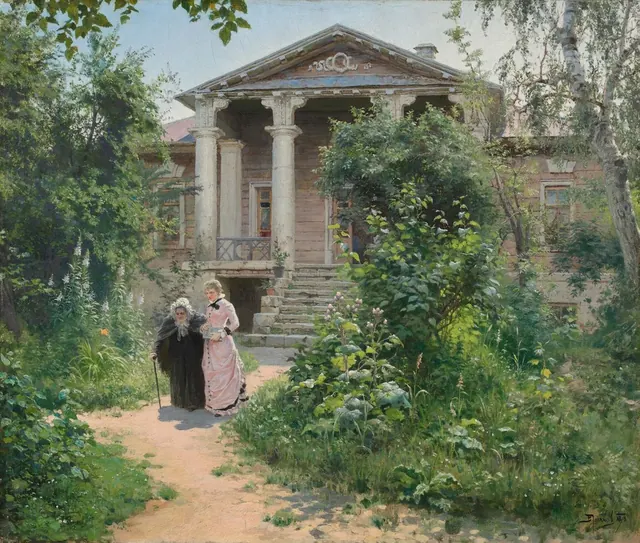
The painting’s story and details
This garden is in Moscow. Vasily Polenov painted it in 1878, soon after moving from St Petersburg. Urban estates still combined a house, service buildings and substantial gardens. A mansion stands behind the trees, and two women walk along a path. Grandmother’s Garden gives the place a family association, while the old house and elderly woman offer two different views of age. The building retains its formal façade; its resident now needs assistance on a walk.
The older woman leans on a stick and holds her companion’s arm. Dark clothing forms a narrow silhouette against the pale path. Her small step and inclined head are visible. There is ample room, yet movement remains slow, governed by the person’s condition. Polenov places this quiet episode before a broad façade. The difference in scale shows how little space an ordinary walk occupies within an extensive estate.
The younger woman’s pink dress gathers in folds at her feet, with dark trim marking collar and hem. Beside it, the elder’s white bonnet frames her face. Their clothes differ in colour and outline. The position of their arms brings the figures together. They form one group while retaining separate silhouettes. Clothing and gesture make a generational difference and an ordinary act of assistance visible.
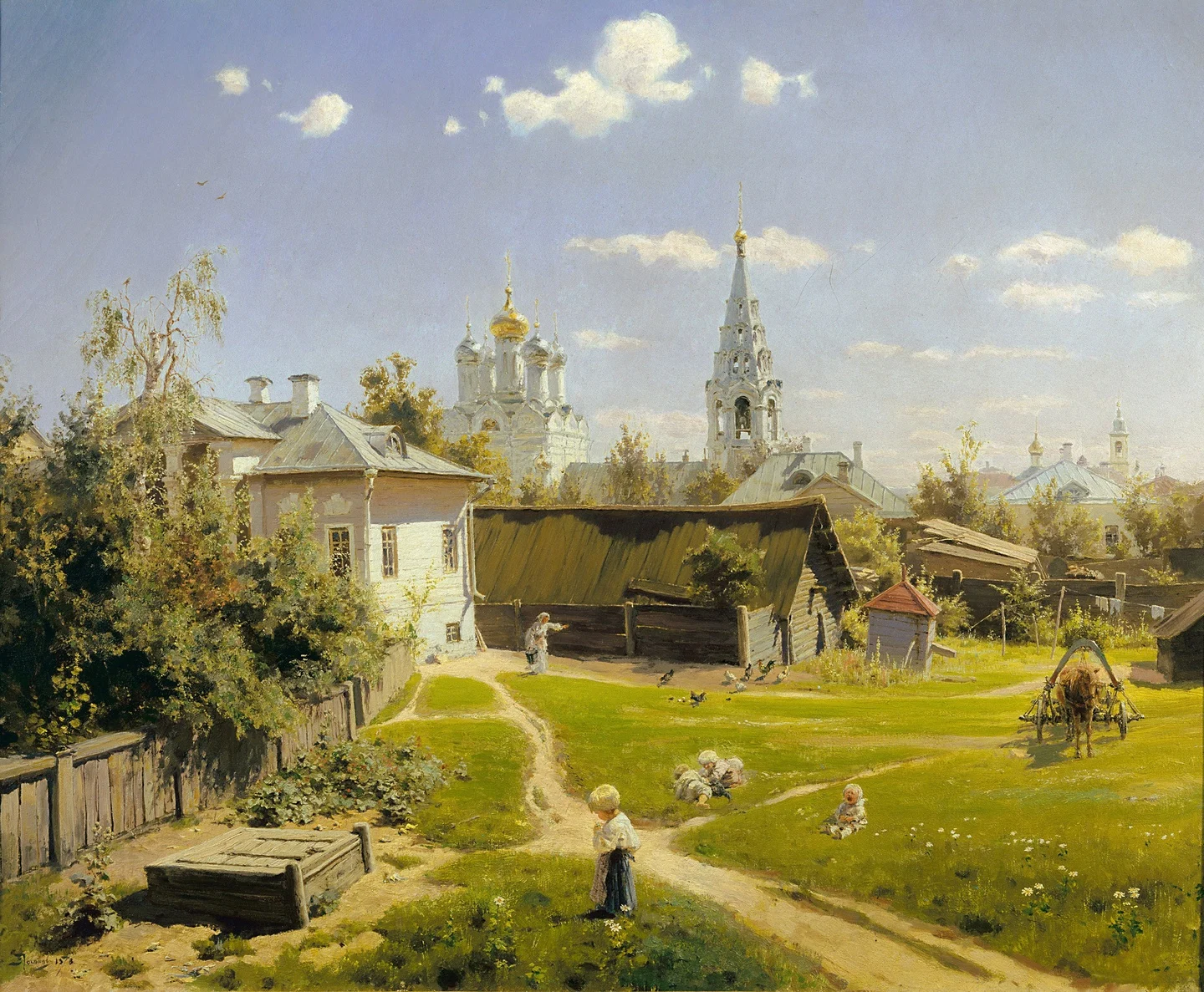
Columns support a triangular pediment above a wooden façade. Such architecture gave a relatively modest Moscow house a formal presence. Researchers connect the building with the Yuryev-Baumgarten estate, where Polenov rented rooms. A very similar portico appears in Moscow Courtyard. Here the house is closer, bringing its ceremonial forms together with worn edges and branches concealing part of the colonnade.
Foliage almost fills the right foreground. Sunlit leaves turn yellowish; shaded ones become cooler and darker. Thin stems and flowers remain visible between larger plants. Polenov places the figures within the same light. The dress’s pink relates to path and façade, while shadows at the women’s feet echo those beneath the leaves. One summer day’s illumination brings figures and building into the same garden.
The steps have uneven edges, with grass reaching the stone in places. Yet flowerpots stand by the porch and the path remains open. The house looks old and inhabited. Wear and everyday care coexist. The pots beside the doorway matter: they show that this old façade still provides the entrance to someone’s home.
The path widens at our feet and narrows towards the porch. Its curve carries the eye past the women to the house, while overhead branches complete the view. The foreground seems accessible, inviting us to imagine walking through it. No street or crowd appears beyond. Polenov selects an enclosed part of Moscow measured by a walk and the distance between a doorway and trees.
Many such estates later gave way to denser urban development. The painting preserves an urban environment familiar to Polenov and now rare. Today we can also consider what lies outside this inviting view: a large garden occupied valuable urban land and required maintenance. Attachment to a place and the question of who can enjoy such tranquillity may arise before the same painting.
Featured in tours
Russian life. Estate, city and village
How nineteenth-century painters depicted work, wealth, education and changes in everyday life.
More paintings to compare


Period, style and subject
- Movement
- Realism
- Genre
- Landscape
- Medium
- Oil on canvas
- Collection
- State Tretyakov Gallery
- Accession number
- 2671
Sources
Tretyakov Gallery reproduction. Noncommercial use with collection credit and source link. Image licence