At the Moulin Rouge
Henri de Toulouse-Lautrec · 1892–95
Explore the painting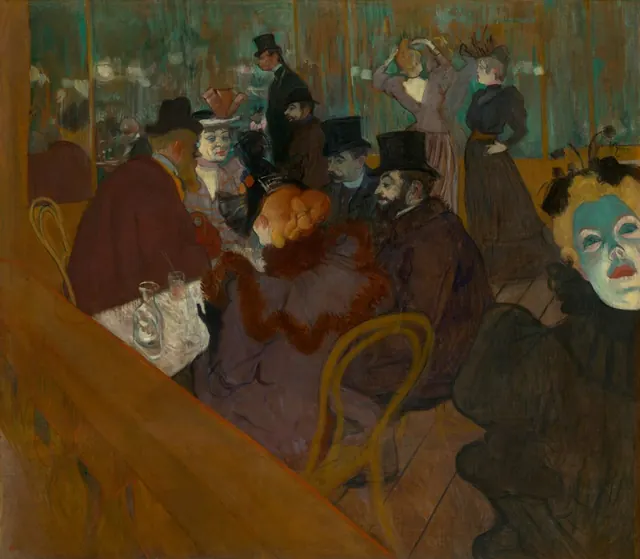
The painting’s story and details
The Moulin Rouge opened in 1889 and quickly became a centre of Parisian entertainment. Toulouse-Lautrec visited regularly, knew its performers and designed posters that helped make them celebrities. Here he gathers his circle inside an electrically lit room. He belongs both among the patrons and among those constructing the establishment’s public image.
The English singer May Milton appears at the right edge. Greenish light sharply alters her skin. Cropped and unusually close, she seems to enter our space. Modern illumination becomes a force that turns a familiar face into an unsettling spectacle.
The red-haired woman at the table has her back to us. She is Jane Avril, whom Lautrec repeatedly depicted in paintings and prints. We are not watching her stage routine. A publicly recognisable performer joins ordinary company among the regular visitors.
People from the painter’s circle occupy the table, including photographer Paul Sescau and wine merchant Maurice Guibert. Art, commerce and entertainment met in shared rooms. The venue fostered relationships, while images of its patrons later became commodities and collectors’ possessions.
In the background La Goulue adjusts her hair before a mirror. Her dancing attracted audiences, and Lautrec’s celebrated poster circulated her image through Paris. Here he shows a brief action outside performance. The difference between public fame and everyday gesture gives her more scope than an advertising silhouette.
Dark dresses form a dense foreground band. They nearly merge while faces and red hair stand out in coloured patches. Lautrec selects distinctive features that make people recognisable. This economy relates to poster design, where an image must register quickly and remain memorable.
Table and railing cut across the room diagonally. We occupy an awkward position beside a group instead of surveying the whole establishment. Presence becomes tangible without granting complete access to the people. A public venue still contains private social circles.
Lautrec himself walks in the background beside his tall cousin, the physician Gabriel Tapié de Céleyran. The small self-portrait easily disappears among the others. It establishes his participation in this world, although the painting constructs something more complex than a record of a chance evening.
Lautrec helped attract visitors to the Moulin Rouge while making its pleasures look ambiguous. Electric light, strangers’ faces and closed groups offer different experiences of one venue. Celebrity recognition remains enjoyable, but we also occupy the position of someone who has not yet entered their circle.
More paintings to compare
 Henri de Toulouse-Lautrec
Equestrienne (At the Cirque Fernando)
1887–88 Henri de Toulouse-Lautrec
The Englishman (William Tom Warrener, 1861–1934) at the Moulin Rouge
1892 Henri de Toulouse-Lautrec
Marcelle Lender Dancing the Bolero in "Chilpéric"
1895-1896 Henri de Toulouse-Lautrec
Portrait of Jeanne Wenz
1886 Henri de Toulouse-Lautrec
Moulin de la Galette
1889 Vincent van Gogh
The Bedroom. Second version
September 1889Period, style and subject
- Movement
- Post-Impressionism
- Genre
- Everyday life
- Medium
- Oil on canvas
- Collection
- Art Institute of Chicago
- Dimensions
- 123 × 141 cm
- Accession number
- 1928.610
Sources
Image provided under CC0. Image licence
Adapted and translated from Art Institute of Chicago materials. · Text licence