Marcelle Lender Dancing the Bolero in "Chilpéric"
Henri de Toulouse-Lautrec · 1895-1896
Explore the painting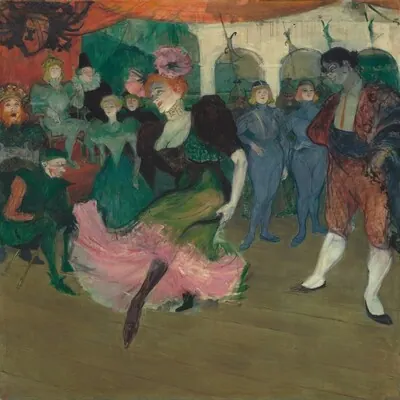
The painting’s story and details
In 1895 the Théâtre des Variétés in Paris revived Hervé’s comic operetta Chilpéric. Marcelle Lender played the Visigothic princess Galswintha. Toulouse-Lautrec attended more than twenty performances, particularly for her second-act bolero. The large painting developed from repeated observation and drawings, as one brief episode held a regular spectator’s attention far beyond its duration on stage.
Lender’s face is lit from below. Footlights give her skin a greenish cast and sharply pick out her chin and chest. Red hair and pink flowers intensify the unusual colouring. This is an actress under stage lighting designed for an auditorium. Makeup, hair and light together create the face of a role, legible from a considerable distance.
The actress lifts both edges of her skirt. Beneath the green-yellow fabric, a pink petticoat opens in broad waves. The colour contrast makes movement legible even in a still image. Lautrec knew theatrical production well, creating posters and programmes and working with costumes and design. Here fabric is one of the dance’s principal instruments.
A leg in a black stocking emerges beneath the skirt. The pointed foot reaches left while the hands hold the fabric open like a fan. A bolero in a story about a sixth-century Frankish king is a nineteenth-century theatrical liberty. Operetta treated history freely, combining political intrigue, striking costumes, popular dances and comic entertainment.
On the right stands Don Nervoso, Galswintha’s brother in the operetta. Hands at his waist, feet apart and an elaborate costume give him an emphatically theatrical importance. His pale stockings echo the brightness of Lender’s underskirts, but he remains nearly still. Against him, the dance at the centre acquires a particularly clear direction and sweep.
King Chilpéric sits on the left. In the plot he plans to marry Galswintha for a political alliance, while his lover Fredegund schemes to kill her rival. Courtiers and scenery establish that intrigue, but occupy relatively little space in the painting. We see the performance with the concentrated attention of someone who came above all for one particular performer.
Lender also appeared in Lautrec’s drawings and colour lithographs. Prints allowed an actress’s image to circulate beyond the theatre, reaching people who might never see the performance. Here that same interest took the scale of a large canvas. Costume, artificial light and a practised gesture preserved the appearance of a production after its theatrical run had ended.
More paintings to compare
 Henri de Toulouse-Lautrec
At the Moulin Rouge
1892–95 Henri de Toulouse-Lautrec
Equestrienne (At the Cirque Fernando)
1887–88 Henri de Toulouse-Lautrec
The Englishman (William Tom Warrener, 1861–1934) at the Moulin Rouge
1892 Henri de Toulouse-Lautrec
Portrait of Jeanne Wenz
1886 Henri de Toulouse-Lautrec
Moulin de la Galette
1889 Vincent van Gogh
The Bedroom. Second version
September 1889Period, style and subject
- Movement
- Post-Impressionism
- Genre
- Everyday life
- Medium
- oil on canvas
- Collection
- National Gallery of Art, Washington
- Dimensions
- Overall, 145 × 149 cm
- Accession number
- 1990.127.1
Sources
Reproduction of a public-domain artwork. Image licence