The Englishman (William Tom Warrener, 1861–1934) at the Moulin Rouge
Henri de Toulouse-Lautrec · 1892
Explore the painting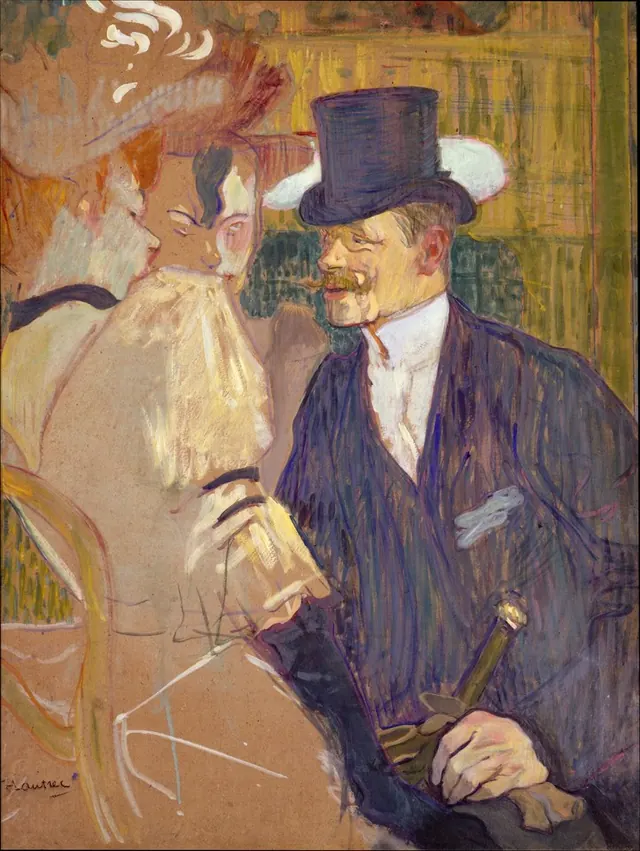
The painting’s story and details
At the Moulin Rouge in Paris, the English painter William Tom Warrener talks with two women. Lautrec knew him and made this work in 1892 as preparation for a colour lithograph. Parisian nightlife supplied the artist with subjects and customers alike. An image of this encounter could subsequently enter a collector’s home, far beyond the dance hall itself.
Warrener leans towards his companions. Lautrec emphasises his projecting nose, curled moustache and red ear. The museum connects this redness with embarrassment at a risqué conversation. Sharpening his features towards caricature makes the figure distinctive. A gentleman’s formal clothes and the close convergence of faces create the comic situation on which the episode depends.
The top hat forms a large dark shape above his face. In scenes of this kind, Lautrec used such headwear to identify prosperous male visitors. Opened in 1889, the Moulin Rouge brought together music, dancing, drinking and opportunities to meet people. Its appeal depended on different social circles encountering one another. A visitor’s clothing preserved these distinctions within the shared entertainment.
The nearest woman turns towards him in profile; the second face appears between them. A high, pale sleeve partly conceals their mouths. A museum publication identifies the women as the dancers Rayon d’Or and La Sauterelle. Lautrec cuts the large hat off at the picture’s edge and brings the heads close together. The viewpoint places us within conversational distance.
Below, Warrener’s hand and a cane with a bright handle continue the attire established by hat, collar and jacket. The cane’s diagonal crosses his nearly upright torso and leads towards the edge. The figure retains the weight of a seated body, although many surrounding areas consist of only a few quick lines.
A small pale accent stands out on the dark clothing near his chest. Long purple and blue strokes describe the jacket, with the brown support showing between them. Lautrec worked in oil on cardboard. Its surface contributes to the overall colour, freeing him from covering every area with paint. Dense white on the collar looks particularly bright beside these thinner passages.
The yellow curve of a chair barely fits along the left edge. The interior is compressed into a chair back, a partition and the space behind the heads. Cropped objects and strong contours connect this painting with Lautrec’s printed work. He made extensive use of devices found in Japanese prints, including unexpected viewpoints and large forms placed close to the edge.
A six-colour lithograph followed this painted study, printed by Edward Ancourt and published by Boussod, Valadon and Co. Printmaking required varied brushstrokes to be translated into coordinated colour layers. A cabaret encounter became an independent commodity in the art market. Lautrec helped construct the fame of nocturnal Paris for both entertainment audiences and buyers of art.
More paintings to compare
 Henri de Toulouse-Lautrec
At the Moulin Rouge
1892–95 Henri de Toulouse-Lautrec
Equestrienne (At the Cirque Fernando)
1887–88 Henri de Toulouse-Lautrec
Marcelle Lender Dancing the Bolero in "Chilpéric"
1895-1896 Henri de Toulouse-Lautrec
Portrait of Jeanne Wenz
1886 Henri de Toulouse-Lautrec
Moulin de la Galette
1889 Vincent van Gogh
The Bedroom. Second version
September 1889Period, style and subject
- Movement
- Post-Impressionism
- Genre
- Everyday life
- Medium
- Oil on cardboard
- Collection
- The Metropolitan Museum of Art
- Dimensions
- 85.7 × 66 cm
- Accession number
- 67.187.108
Sources
Image provided under CC0. Image licence