The Bedroom. Second version
Vincent van Gogh · September 1889
Explore the painting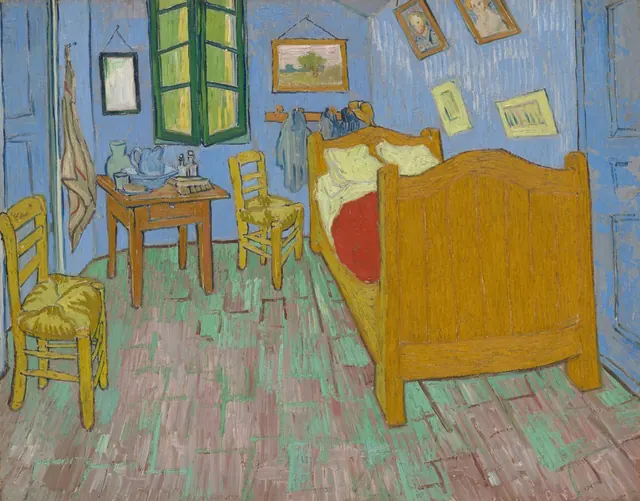
The painting’s story and details
Van Gogh depicts his bedroom in the Yellow House in Arles. Yet he painted this canvas elsewhere, in September 1889, while receiving treatment in Saint-Rémy. It is the second version. The first had appeared almost a year earlier, shortly after he moved into the house where he hoped to establish a shared studio. Repetition let him return to a work he valued, which had already suffered damp damage. The familiar room became the subject of a painting made away from it.
The bed occupies almost half the canvas. Yellow-orange wood, a red blanket and pale pillows form broad areas of colour. Writing to Theo about the first version, Van Gogh explained that colour itself should convey rest and sleep. The furniture was meant to appear solid and stable. Yet the bed’s long lines recede sharply, and the paint is applied in energetic strokes. Even knowing the intention, we may feel tension in the space. An artist chooses expressive means without being able to determine every viewer’s response.
A male and a female portrait hang above the bed. In the first version these were Van Gogh’s friends, the painter Eugène Boch and Lieutenant Paul-Eugène Milliet. In the Chicago repetition, the museum identifies a self-portrait and an imagined woman. Researchers suggest connecting this pair with the artist’s desire for domestic companionship. This is a possible reading of the change, not an established account of a particular woman. Repeating his painting, Van Gogh allowed himself to alter details he had previously recorded from life.
Green strokes lie beside pinkish-brown areas on the floor. In his letter about the first version, however, Van Gogh called the tiles red. Museum research found different underlying layers and red pigments in the three paintings; those pigments have changed over time. Paint losses also affect their appearance. The colour we see today cannot therefore be attributed entirely to the artist’s original decisions. Letters and material examination help recover information that a reproduction alone cannot provide.
The chair at the left edge is close to us. Thick paint describes its woven seat, with shades of yellow separating one strand from another. A second chair stands against the far wall. Van Gogh returned to this plain furniture in separate paintings too. He chose a modest pine chair for himself and a more elaborate walnut armchair for Gauguin. Furniture could suggest its owners’ characters without including the people themselves. In The Bedroom, objects likewise give a detailed account of daily living.
A jug, basin and small washing accessories fill the table, with a towel hanging nearby. The orange tabletop and blue vessels are clearly distinct. In his 1888 letter, Van Gogh explained that he was removing shadows and using flat areas of colour after the example of Japanese prints. In this repetition, objects retain dark outlines while cast shadows largely disappear. The simple furnishings become a clear arrangement of coloured forms. Washing, sleeping and resting are represented through things a person uses each day.
The green window leaves are angled. Comparing the three versions, the museum notes that both appear slightly open in the Chicago painting. The view outside is barely developed. The window remains a large green area among the walls, while the small mirror provides another pale rectangle. Van Gogh repeats frames and doorways, varying their size and tilt. The room can be examined both as a living space and as a composition of lines and coloured planes.
The blue door on the right closes the edge of the room. When working on this version, Van Gogh had the damaged first canvas before him. In June 1889 he asked Theo to send it back. He had previously doubted his ability to repeat the work; now he felt calmer and ready to try. In the same letter, he thanked his brother for canvases, paints and brushes. Returning to painting depended on both his condition and the material assistance that allowed him to work.
Van Gogh soon made a third, smaller Bedroom for his mother and sister. The same image could preserve an artistic idea he valued and become a gift for people close to him. The Chicago version later passed through private collections, entering the museum as a gift from Frederic Clay Bartlett in 1926. The three paintings are now in Amsterdam, Chicago and Paris. Similar at first glance, their altered portraits, window and paint handling show Van Gogh reconsidering what the room should look like each time.
Featured in tours
For children. Everyday life before us
Homes, school, trains and games in twelve paintings. For ages 8–12 and adults.
After Impressionism. Four different answers
Seurat, Cézanne, Van Gogh and Gauguin changed painting for different reasons.
More paintings to compare
 Vincent van Gogh
Self-Portrait
1887 Vincent van Gogh
Madame Roulin Rocking the Cradle (La berceuse)
1889 Vincent van Gogh
Irises
1890 Vincent van Gogh
Self-Portrait with a Straw Hat (obverse: The Potato Peeler)
1887 Vincent van Gogh
Wheat Field with Cypresses
1889 Vincent van Gogh
The Large Plane Trees (Road Menders at Saint-Rémy)
1889Period, style and subject
- Movement
- Post-Impressionism
- Genre
- Everyday life
- Medium
- Oil on canvas
- Collection
- Art Institute of Chicago
- Accession number
- 1926.417
Sources
- Art Institute of Chicago · The Bedroom
- Museum data, provenance and bibliography · The Bedroom
- Letter 705 · Vincent van Gogh to Theo, Arles, 16 October 1888
- Letter 779 · Van Gogh to Theo, Saint-Rémy, 9 June 1889
- Letter 800 · Van Gogh to Theo, Saint-Rémy, 5–6 September 1889
- Letter 829 · Van Gogh to Theo, Saint-Rémy, about 19 December 1889
- Exhibition Van Gogh’s Bedrooms (2016) · about the paintings
- Van Gogh’s Bedrooms · the portraits
- Van Gogh’s Bedrooms · the floor
- Van Gogh’s Bedrooms · the chair
- Van Gogh’s Bedrooms · the bed
- Comparing the three versions · The Window
Open-access Art Institute of Chicago reproduction, CC0. Image licence