Still Life with Game Fowl
Juan Sánchez Cotán · c. 1600–3
Explore the painting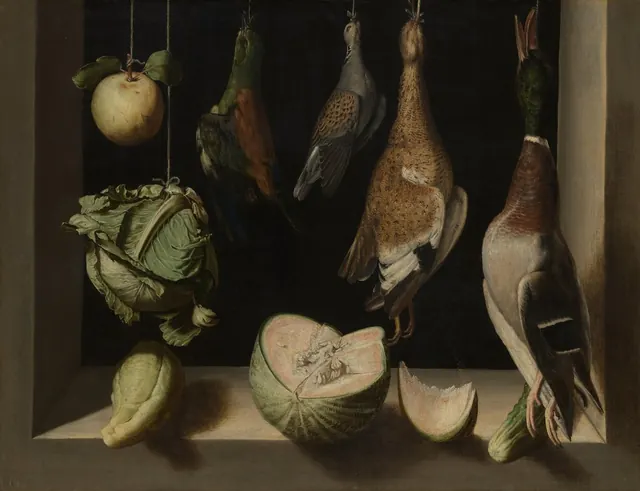
The painting’s story and details
Juan Sanchez Cotan painted this still life around 1600–03, as independent depictions of objects became a European specialisation. Fruit, vegetables and hanging game occupy a stone niche. The painter had worked successfully in Toledo for about twenty years. In 1603 he entered a Carthusian monastery in Granada, although that later decision cannot by itself explain every earlier object.
A quince hangs from a fine cord at the left. Leaves, blemishes and irregular skin receive close attention. Darkness reveals small surface differences. Suspension frees the fruit from resting beside other objects and makes surrounding emptiness part of the arrangement.
A cabbage hangs below. Folded leaves range from bright ribs to nearly black recesses. Its complexity differs from the rounded quince, although both are suspended. Common illumination and a restricted setting reveal their different natural structures.
A cut melon rests on the ledge. Seeds, flesh and striped rind appear together. The opening supplies both an exterior and interior view. Recognisable food invites a concentrated comparison of surfaces extending beyond ordinary kitchen attention.
A separate slice lies nearby. A small shadow establishes its thickness and contact with stone. Objects projecting towards us make the niche almost tangible. Their presence is persuasive, although strict placement reveals a carefully constructed arrangement.
A large bird hangs among the other carcasses. Its plumage differs in pattern and density, with legs extending beneath the body. The birds are suspended near their heads or necks. This elongates their silhouettes and links them to vertical cords. Evidence of handling game becomes part of the still life's strict design.
On the right, a long bird nearly connects the upper edge with the ledge. Pale breast, dark wing and green head add another combination of colour and texture. A cucumber lies nearby. Objects of different lengths gather at the niche's edge while retaining space for individual inspection.
A smaller bird near the centre has finely patterned feathers. Changes of scale prevent monotonous repetition. Yet these dead animals also remain prospective food. That aspect may be more conspicuous for a modern viewer than for someone accustomed to game in a household.
Side lighting unifies the objects while black depth removes distractions. The museum stresses the still life’s geometric organisation. Empty intervals hold attention at each form. Cotan’s later monastic life allows this concentration to suggest contemplation. Yet the precisely depicted game and produce retain connections with kitchens, food and bodily existence. Ordinary uses meet an extraordinary intensity of attention, giving the still life its significance.
Featured in tours
Still life. The value and structure of things
Food, flowers, vessels, books and instruments in an owner’s life and a painter’s work.
More paintings to compare
Period, style and subject
- Movement
- Baroque
- Genre
- Still life
- Medium
- Oil on canvas
- Collection
- Art Institute of Chicago
- Dimensions
- 67.8 × 88.7 cm
- Accession number
- 1955.1203
Sources
Image provided under CC0. Image licence
Adapted and translated from Art Institute of Chicago materials. · Text licence