A Bouquet of Flowers
Clara Peeters · ca. 1612
Explore the painting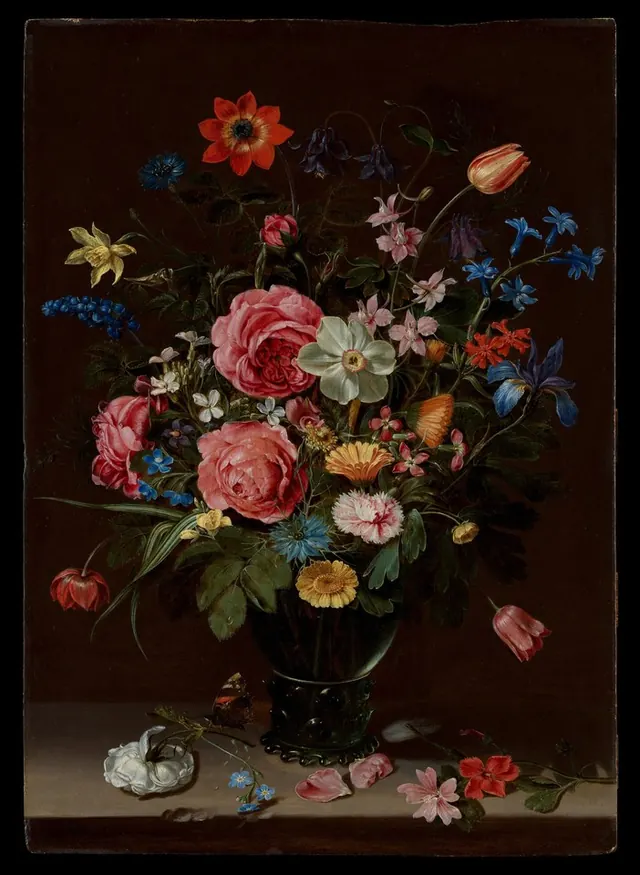
The painting’s story and details
Clara Peeters painted this bouquet around 1612, when still life was only beginning to establish itself as an independent genre in the Southern Netherlands. The large bouquet occupies almost the entire surface, from its tallest stems to fallen petals on the table. For Peeters, this choice formed part of a professional career. Her works reached collections in different European cities, which Prado researchers associate with participation in the art market.
A large rose opens towards the light. Its inner petals are dark red, while the outer edges approach white; nearby roses face other directions. Petals curl and overlap one another. Each angle changes the pattern of petals and the depth of shadows. Attention to plant structure connects flower painting with botanical imagery. The bouquet also retains an overall arrangement, with large pale flowers concentrated near the middle.
The vase is dark green glass. Raised ornaments and small highlights appear around its base, while stems can be made out in its upper part. The vessel is transparent enough to suggest depth but remains much darker than the flowers. Glass, stone and a thin petal require different handling. On this small wooden panel, Peeters distinguishes them through edges, reflections and degrees of transparency.
The striped tulip on the right rises on a long curved stem. Red markings follow its pale petals. Another tulip hangs below the bouquet. The plants produce an uneven silhouette, with individual stems projecting far from the crowded middle. Accurate flowers coexist with a conspicuous arrangement. Dark intervals between the upper blossoms keep the slender stems legible.
A pale flower with a small yellow-and-red centre opens beside the rose. Its broad petals are almost flat compared with the rose’s many folds. Smaller flowers and leaves surround it. Differences in size and structure make the bouquet resemble a collection of individual observations. Light distinguishes each kind, while the dark background reveals even the thin outer rim of a pale petal.
A white rose lies on the stone ledge. A butterfly appears nearby, and tiny blue forget-me-nots bend towards the edge. The main bouquet contains flowers at different stages of opening; here there are cut stems and fallen petals. The museum connects these details with the brevity of flowering.
Individual flowers and petals lie at the lower right. Their short shadows establish the ledge as a solid surface. On its front edge, Peeters added her name. The signature connects the labour of describing so many fragile things with a specific maker. It is especially valuable because surviving documents about Peeters are scarce, and scholars reconstruct much of her biography from the works themselves.
Women in her time were often excluded from studying nude models. This restricted preparation for history painting, which ranked above still life. An inequality followed: a more accessible genre was considered less intellectual, despite demanding complex observation and skill. Peeters’s bouquet exposes the limitations of that hierarchy. She was working in a field whose possibilities she herself helped expand.
Featured in tours
Women painters. Learning and working
Family workshops, academies, private commissions and independent exhibitions.
Still life. The value and structure of things
Food, flowers, vessels, books and instruments in an owner’s life and a painter’s work.
More paintings to compare
Period, style and subject
- Movement
- Baroque
- Genre
- Still life
- Medium
- Oil on wood
- Collection
- The Metropolitan Museum of Art
- Dimensions
- 46 × 32 cm
- Accession number
- 2020.22
Sources
Image provided under CC0. Image licence