Banquet Piece with Mince Pie
Willem Claesz Heda · 1635
Explore the painting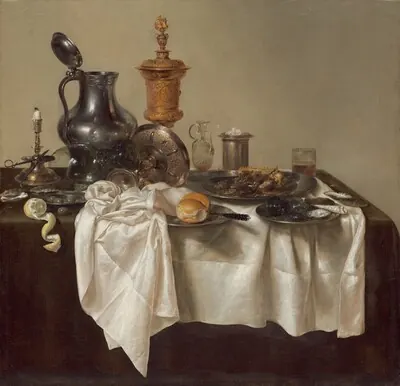
The painting’s story and details
Someone has already eaten. The pie is cut, drinking vessels are overturned, and the cloth is rumpled. Heda painted this still life in 1635. He specialized in laid tables, an established genre in Dutch painting. Such pictures allowed prolonged attention to things that would quickly disappear during a real meal. Here both expensive tableware and signs of its use have been preserved.
The pewter pitcher has dents and broad, dull reflections. Heda leaves signs of wear visible. Nearby, transparent glass lets light through while metal returns it in pale patches. The painter differentiates materials within a narrow range of greys and browns. A change in an edge, a highlight or a shadow is enough to distinguish one object from another.
The tall gilded cup rises above the other vessels. Its small relief ornaments catch many points of light, while the pitcher beside it reflects light broadly. Height and elaborate decoration identify the cup with formal display. Yet disorder already surrounds it. An expensive object stands among leftovers, making the table’s grandeur look temporary.
The lemon has been peeled in a long spiral. Its rind crosses the table’s edge, bringing the objects visually closer to us. Above it stands a nearly spent candle with a snuffer. The museum connects this pair with a reminder of life’s brevity. The remains of the finished meal support that reading. The pleasure has ended, leaving its traces on the table.
The pie has been opened, exposing its dark filling. A roll with a piece broken off rests nearby, and a broken glass lies in front of the pie. These different states make elapsed time visible. We notice the cut pie, the roll’s exposed crumb and the sharp edges of glass. With the diners absent, the story of the recent meal has to be reconstructed from what remains on the table.
The white cloth occupies nearly the entire lower half of the painting. Its folds change direction, gather beneath the vessels and fall freely over the edge. They contain many shades of grey, cream and brown. This pale expanse holds the numerous dark objects together. What looks like accidental disorder acquires a clear structure through the fabric linking its separate parts.
The table attracts us through its richness while showing how quickly enjoyment ends. That tension keeps the still life alive. We can admire the metalwork, transparent glass and pastry even as we notice broken tableware and the extinguished candle. The painting preserves the meal’s temptations within an image of its ending. We are left to decide which has greater force: the warning or the pleasure of looking.
Featured in tours
Still life. The value and structure of things
Food, flowers, vessels, books and instruments in an owner’s life and a painter’s work.
More paintings to compare
Period, style and subject
- Movement
- Baroque
- Genre
- Still life
- Medium
- oil on canvas
- Collection
- National Gallery of Art, Washington
- Dimensions
- Overall, 106.7 × 111.1 cm
- Accession number
- 1991.87.1
Sources
Reproduction of a public-domain artwork. Image licence