Wounded Eurydice
Camille Corot · 1868–70
Explore the painting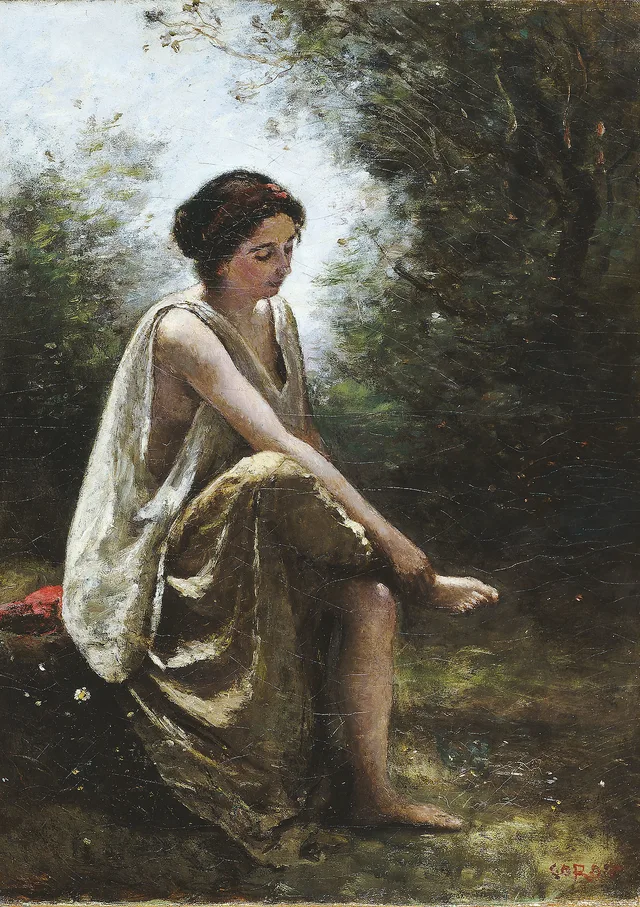
A woman in a wood raises her leg to inspect a wound. The title identifies her as Eurydice, wife of the singer Orpheus. In the ancient myth she dies from a snakebite, prompting Orpheus to seek her in the underworld. Corot chose the tragedy’s opening. The journey among the dead is still to come; here a person is simply trying to understand what has happened to her.
Eurydice lowers her head, her face partly obscured by its angle and shadow. Corot dispenses with an open mouth or dramatic grimace. The bent neck and concentrated gaze explain her attention to the injured leg. Viewers who know the myth already understand its outcome. Anxiety arises between that knowledge and her restrained behaviour, without requiring an additional theatrical gesture.
The raised foot rests across her other leg, and a hand approaches the ankle. The gesture is familiar to anyone who has inspected a bruise or scratch. It makes the ancient subject physically accessible without prior knowledge of the entire story. Corot emphasises a small action that will prove to mark an irreversible event in two people’s lives.
Pale clothing gathers in broad folds across the chest and knees. It recalls classical drapery but is painted in soft patches with little elaborate detail. The exposed shoulder and legs make the body’s position clear. Greyish fabric, skin and foliage have few abrupt colour contrasts, so the figure seems closely integrated with the surrounding wood.
Dark trees form a dense wall on the right, while a lighter space opens on the left. The landscape contains no spectacular catastrophe. Its calm persists independently of human misfortune. Corot, best known for landscapes, could place a mythological story within his familiar investigation of tone, openings of sky and woodland depth.
Small pale flowers appear near her feet. They give the ground specificity without explaining the event. There is no need to assign them a compulsory meaning of death. The title and the woman’s gesture establish the episode. Other details make the woodland setting tangible: an ordinary environment in which danger could go unnoticed.
In this version of the story, attention belongs entirely to Eurydice. Orpheus is absent, and she attends to her own pain. This choice allows us to consider the experience of the woman whose death usually begins an account of her husband’s exploits. The painting is small, and its quiet action rewards close looking. An ancient tragedy is contained within a single arrested everyday gesture.
More works by Camille Corot
- Medium
- Oil on canvas
- Collection
- Art Institute of Chicago
- Accession number
- 1894.1042
Sources
Wikimedia Commons reproduction. Public domain. Image licence