Hagar in the Wilderness
Camille Corot · 1835
Explore the painting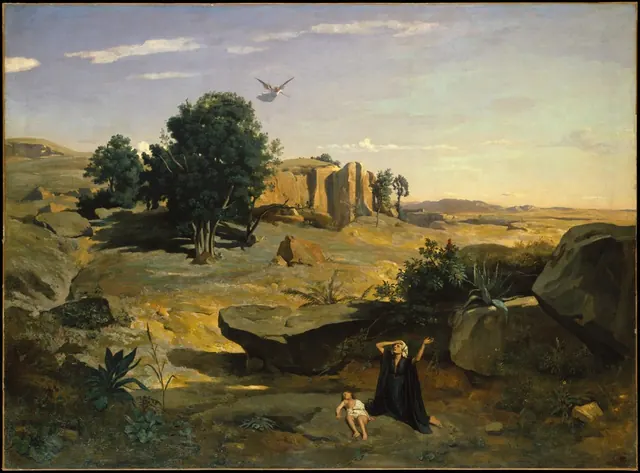
The painting’s story and details
Hagar and her son Ishmael have run out of water. In the biblical account, their distress begins with a family dispute over inheritance. Sarah demands that the enslaved woman’s son should not share it with her son Isaac. Abraham sends Hagar and the boy into the wilderness. Corot shows the consequences, when help must come from outside.
Hagar kneels with her arms raised. Her dark clothing merges with the shadow beside the rocks, her face turned upward. In Genesis she moves away because she cannot bear to watch her son die. Corot brings the two figures close together, concentrating maternal despair and the child’s helplessness in a single group.
Ishmael lies beside her with an arm hanging down, small against the slabs of rock. The dry watercourse explains why this landscape becomes a place of distress. Water is expected here but cannot be found.
An angel appears high above the tree. Almost the full height of the painting separates him from the mother. In the biblical text, God opens Hagar’s eyes and she sees a well. Corot chooses the moment before rescue. The viewer notices the approaching angel while the figures below remain among the dry stones.
The large oak on the left grew somewhere else entirely. Corot transferred it from a study made in Fontainebleau forest in 1832 or 1833. Observation of French nature became part of an imagined Palestine. He used the familiar tree, its dense crown and shadow, to construct a convincing setting for an ancient story.
The sunlit escarpment and distance are built from clear, broad forms. This is the early Corot, far from the soft silvery haze of his later landscapes. On his travels he painted outdoors; in the studio he developed large religious and mythological compositions. This painting was intended for the Paris Salon of 1835.
The canvas is over two and a half meters wide, yet the people occupy only a small part. For public exhibition, Corot brought a major biblical subject together with his experience as a landscape painter. Rock, shadow, the dry channel, and the distance to the angel give Hagar’s plight its physical form across the canvas.
More paintings to compare
Period, style and subject
- Movement
- European painting
- Genre
- Religious art
- Medium
- Oil on canvas
- Collection
- The Metropolitan Museum of Art
- Dimensions
- 180.3 × 270.5 cm
- Accession number
- 38.64
Sources
Image provided under CC0. Image licence