View of Genoa
Camille Corot · 1834
Explore the painting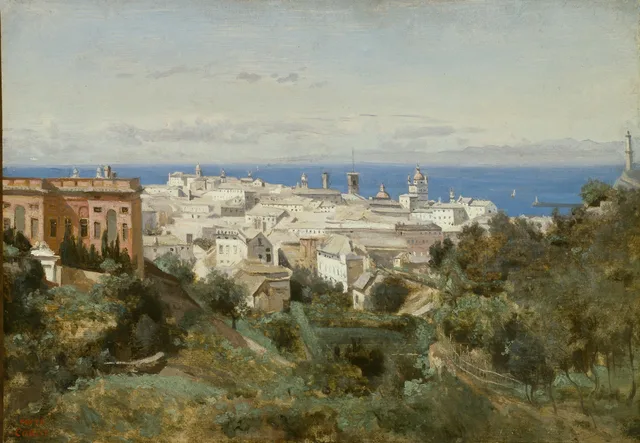
Corot painted this view of Genoa in 1834 during his second journey to Italy. His first, in 1825–28, had been an important part of his training. Family support allowed him to leave commerce and devote himself to painting. Italian studies taught him to observe relationships between light, architecture and space. In Genoa he chose a high position from which the city extends from nearby gardens to the sea.
The pinkish house on the left stands closer than the other buildings. Dark windows and tall greenery beside the wall establish its scale. This warm area begins the movement into depth. Corot separates distances without theatrical lighting. Contrasting the saturated near façade with paler buildings beyond is enough to make recession legible.
Central roofs form a complex assembly of sloping planes. Some walls are almost white, while others enter grey shadow. Corot does not describe every house with equal detail. He selects the signs through which the city reads as dense construction. Windows become small marks, while relationships between roofs retain clarity and conviction.
Towers and domes rise above ordinary houses. They give Genoa’s skyline a recognisable rhythm, distinguishing public buildings from residential fabric. Yet no monument receives isolated ceremonial emphasis. Corot’s attention extends across the view. Architectural landmarks share the city’s illumination with unremarkable roofs and walls.
The sea forms an even blue band beyond the buildings. Small sails and harbour structures connect the city with maritime movement, although commerce is scarcely depicted. The elevated viewpoint turns a working port into a calm area of colour. That is a consequence of the chosen distance. The economic life sustaining Genoa becomes part of the overall landscape.
Paths and walls pass through foreground greenery, suggesting a garden or hillside above the city. Vegetation is handled more freely than architecture. Irregular brush touches give foliage density, while paths direct attention towards buildings. The paper on which the work was originally painted in oils suited a portable study; it was later mounted on canvas.
Views of this kind helped Corot combine accurate observation with selection. Counting every window is unnecessary for understanding the city. Its pictorial force depends on large areas of colour and a few characteristic details. Later he would frequently return to memories of Italy. Here we particularly sense an eye learning to gather a complex panorama onto a small painted surface.
More works by Camille Corot
- Medium
- Oil on paper, mounted on canvas
- Collection
- Art Institute of Chicago
- Accession number
- 1937.1017
Sources
Wikimedia Commons reproduction. Public domain. Image licence