Interrupted Reading
Camille Corot · c. 1870
Explore the painting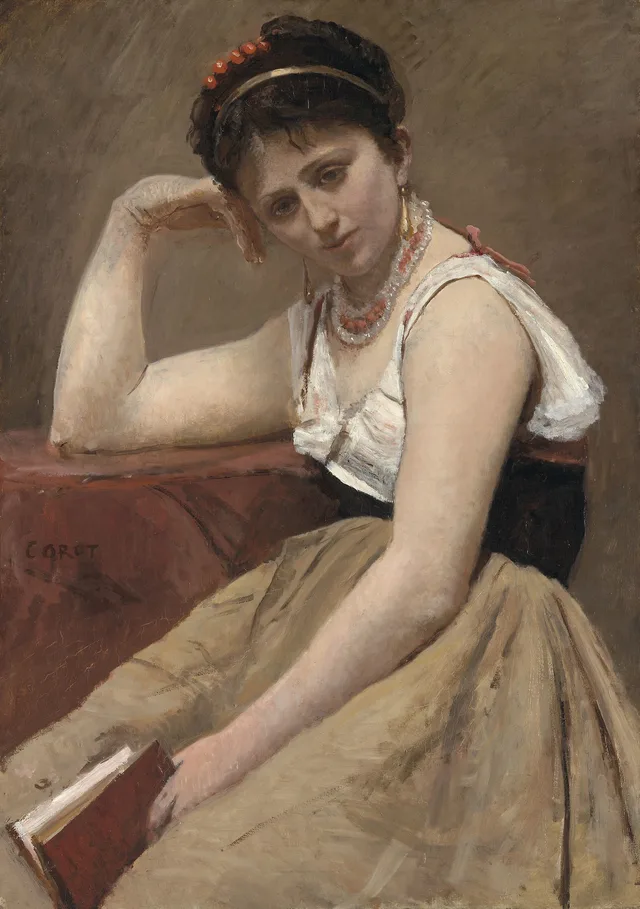
Camille Corot is best known for landscapes, but devoted considerable attention to the human figure in his later years. He rarely exhibited paintings of this kind, which retained the more private character of studio studies. In Interrupted Reading, painted around 1870, a model occupies the studio beside a book and table. Corot constructs a brief pause that can be read as an episode from life, although clothing, pose and setting were carefully chosen for the picture.
Her head inclines towards her hand, while her eyes look away from the book. That creates the pause named in the title. The face is softly modelled through small transitions of light and shade. We may sense concentration or reflection, but the content of her thoughts remains inaccessible. Corot supplies signs of an inner life without connecting them to a particular event. The figure retains an independence: her attention need not become fully intelligible to the person looking at her.
The book is lowered to her lap and held in one hand. Its reddish binding echoes the cloth on the table, connecting the lower corner with the centre. Reading was a familiar subject in European painting, associated with private life and education. Here the book’s title cannot be read, so the meaning does not depend on a literary quotation or a particular author. The object suggests an activity that can continue in the mind after the eyes have left the page.
The raised arm rests on the table at the elbow, forming a stable triangle. The other arm extends downwards, creating contrasting directions. Corot builds the body from large connected masses. The construction reflects the experience of a painter accustomed to organising trees, hills and water in a landscape. A soft impression does not mean vague drawing. Shoulder, forearm and elbow are positioned so that a still pose can sustain attention.
The white blouse, dark bodice and jewellery give the clothing an Italian character. Corot spent substantial periods in Italy and continued using such costumes in his studio. The dress should therefore not be treated as an accidental record of a Parisian reader’s everyday clothing. It brings the painter’s memory and artistic tradition into the scene. Observation of a living model combines with staging, giving a contemporary sitter an appearance that could recall earlier painting.
A broad skirt fills much of the lower canvas. Freely brushed folds retain the fabric’s direction without detailed finishing. Pink and grey touches enliven its restrained golden-brown colour. Beside this large area, the flesh appears especially smooth. Different handling distinguishes body from clothing within one quiet palette. Corot lets the eye alternate between the material surface of paint and a convincing human presence.
A private scene has been made for someone else to see, giving it a particular tension. We observe a model in a carefully selected costume, yet perceive a person briefly alone with herself. The book and diverted gaze make that illusion convincing. The painting reveals the complexity behind pictorial simplicity. An apparently natural pause required a traditional subject, memories of Italy, a studio arrangement and the precise organisation of a body within limited space.
Featured in tours
Domestic life. Leisure and care
Sixteen paintings about reading, music, children and the work that makes domestic comfort possible.
More works by Camille Corot
- Medium
- Oil on canvas, mounted on board
- Collection
- Art Institute of Chicago
- Accession number
- 1922.410
Sources
Wikimedia Commons reproduction. Public domain. Image licence