Columbine
Nikolai Sapunov · 1910
Explore the painting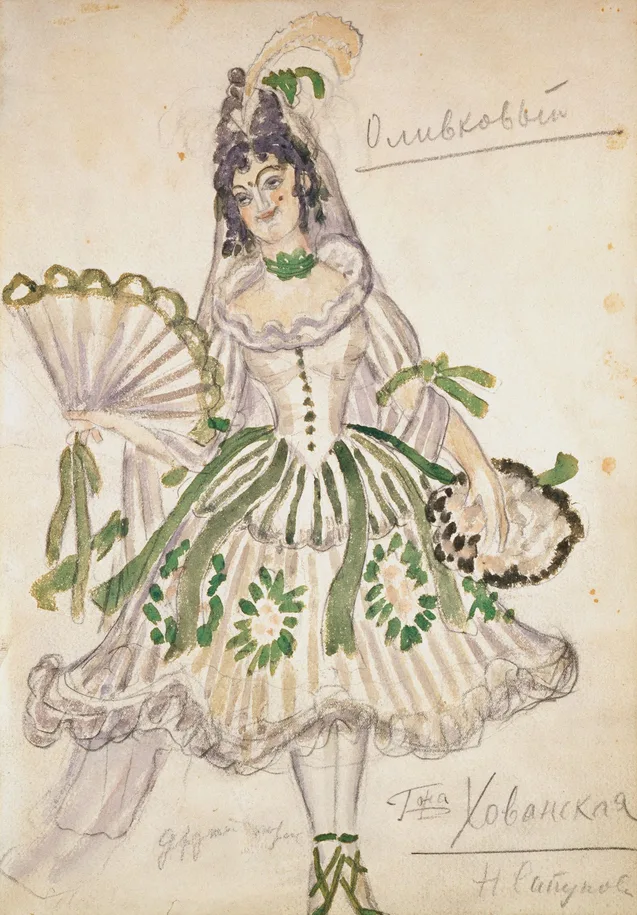
This watercolour was a working costume design. Nikolai Sapunov made it for Columbine’s Scarf, a pantomime staged by Meyerhold in St Petersburg in 1910 after Arthur Schnitzler. Ekaterina Khovanskaya played the lead. The sheet combines an inherited theatrical character with the appearance of a contemporary performer who would bring the costume to life.
Emphasised eyes and a small beauty spot recall stage makeup, designed to be read from the audience. Sapunov retains Khovanskaya’s likeness while heightening her features. In pantomime, movement, posture and expression carry meaning, giving the character’s visible appearance some of the work performed by speech in a spoken play.
A tall hairstyle and feathers extend the silhouette above the head, keeping it recognisable through movement and changing light. Sapunov uses older theatrical conventions in which costume immediately signals a role. Historical elements are freely combined for an effect intended to engage contemporary audiences.
The open fan occupies almost as much space as the upper torso. In performance it could reshape a gesture, conceal the face or extend an arm’s movement. Sapunov includes an object with acting possibilities. A costume design becomes a proposal for behaviour, although the sheet records only one fixed pose.
Green stripes, bows and floral patterns connect different parts of the dress. A colour note shows the sheet’s practical purpose. The watercolour had to communicate both the character’s effect and a costume solution. Free drawing coexists with instructions to be translated into actual fabrics and trimmings.
Crossed ribbons on the shoes carry the dress’s green rhythm to the floor. Lower-body details mattered in pantomime, where the whole body was watched. The production played at the House of Interludes, a small cabaret theatre with audience tables. Steps connected stage and spectators, giving the figure a particularly immediate presence.
The House of Interludes lasted only a few months, but Columbine’s Scarf became a memorable theatrical experiment. Khovanskaya combined comedy and tragedy, and Sapunov gave that performance a visible form. The surviving sheet records art initially intended for a production’s brief life. In a museum, a working document becomes an independent image while preserving a collective project.
- Medium
- Watercolour and graphite on paper
- Collection
- State Tretyakov Gallery
- Dimensions
- 30.5 × 21 cm
- Accession number
- Р-5519
Sources
Public-domain artwork. Digital reproduction from the State Tretyakov Gallery. Image licence