Self-Portrait
Paul Gauguin · 1889
Explore the painting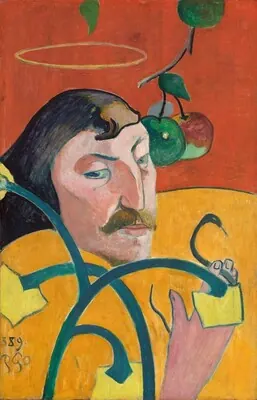
The painting’s story and details
In 1889 Gauguin lived at Le Pouldu in Brittany. This self-portrait was intended for the decoration of a local inn alongside a portrait of his fellow painter Meijer de Haan. Gauguin painted himself on a wooden panel. The everyday setting acquired an unusual inhabitant: an enormous haloed head beside apples and a serpent-like plant. The artist presented himself through a legend of his own making.
The face, with its large nose, moustache and raised eyebrow, occupies much of the panel. Separated from the body, the head seems to float above the yellow field. The hairline continues into a dense dark mass. Recognisable features are enlarged and simplified, approaching caricature. The face and surrounding signs fill the panel, leaving only a head and hand of the figure.
The thin golden ring above the head is recognisable as a halo. Beneath it, however, is the artist’s earthly face, without a conventional depiction of a saint. Gauguin appropriates a sign of spiritual authority. In the museum’s reading, it belongs to his conception of the artist as an exceptional person able to claim special knowledge.
Two apples hang at the right. In Christian painting they often signify the forbidden fruit and the Fall. Gauguin places them almost against his forehead while directing his gaze elsewhere. Temptation sits beside the halo. The painting combines signs usually distributed among different participants in a religious story.
Green curves rise from the lower edge. They resemble a stem, but a serpent’s head appears beside the fingers. The artist holds it lightly, without alarm. The snake connects the apples to biblical temptation, while its transformation into ornament destabilises the boundary between plant and creature. This invented, flexible form fills the lower section.
The background divides into red and yellow fields, separated by a dark line without an attempt at deep space. Red surrounds the halo; gold lies below, beside the serpent. The colours therefore offer no simple division into “good” and “evil” halves. Contradictory signs are gathered into a single image that Gauguin presents as his own.
The painting remained with the innkeeper Marie Henry in lieu of rent. The legend of the independent artist had a practical economic side. In the image Gauguin combines sanctity and temptation; in life the work settles a debt to his landlady. That difference is particularly striking where almost ecclesiastical signs originally decorated an inn interior.
Featured in tours
After Impressionism. Four different answers
Seurat, Cézanne, Van Gogh and Gauguin changed painting for different reasons.
More paintings to compare
 Paul Gauguin
Merahi metua no Tehamana (Tehamana Has Many Parents or The Ancestors of Tehamana)
1893 Paul Gauguin
Mahana no atua (Day of the God)
1894 Paul Gauguin
Ia Orana Maria (Hail Mary)
1891 Paul Gauguin
Fatata te Miti (By the Sea)
1892 Paul Gauguin
Where Do We Come From? What Are We? Where Are We Going?
1897–1898 Paul Gauguin
Arlésiennes (Mistral)
1888Period, style and subject
- Movement
- Symbolism
- Genre
- Portrait
- Medium
- oil on wood
- Collection
- National Gallery of Art, Washington
- Dimensions
- Overall, 79.2 × 51.3 cm
- Accession number
- 1963.10.150
Sources
Reproduction of a public-domain artwork. Image licence