Tsarevna Sophia at the Novodevichy Convent
Ilya Repin · 1879
Explore the painting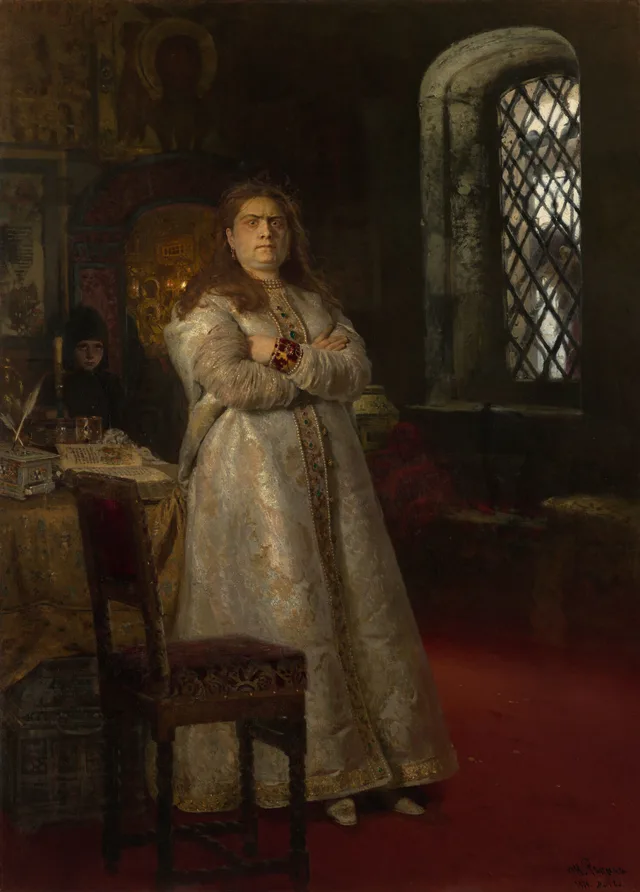
The painting’s story and details
Repin painted Tsarevna Sophia in 1879, depicting her confinement after the struggle for power with Peter. Educated and politically active, she had governed as regent for her younger brothers. He places her in a convent cell during the executions of the Streltsy in 1698. The scene centres on someone who has lost power but retains an authoritative bearing.
Sophia looks straight ahead with drawn brows. Repin gathered historical material and searched for a suitable appearance, but this is an imagined presence from the seventeenth century. Contemporary viewers found the expression startlingly forceful. Psychological proximity made it difficult to contain the image within a safely concluded past.
Her tightly folded arms form a nearly horizontal barrier, closing and steadying the figure. The gesture suggests resistance to a submissive posture despite circumstances already decided. In a story of lost power, the body becomes the remaining space in which the figure can retain an independent bearing.
A barred window reveals an executed Streltsy soldier outside. A large event enters the room through a small inaccessible opening, establishing the threat surrounding Sophia. Repin withholds a panoramic history scene, showing a fragment whose impact is intensified by confinement.
The pale dress occupies the dark cell’s centre. It was specially made from Repin’s sketches for the painting. Historical conviction emerges through contemporary practical work: actual fabric can be lit and studied, making an imagined encounter with the past materially credible.
A woman in the background nearly disappears beside the table and icons. Her smaller dark figure intensifies Sophia’s solitary presence even though she is not literally alone. Domestic and religious objects establish the convent setting into which the former ruler has been placed.
The painting divided even Repin’s close contemporaries. Kramskoy defended its force while others found it excessive. Political persecution and women’s position made the subject especially resonant in the late nineteenth century. Sophia concerns two periods at once: the selected historical episode and the concerns of the society to which Repin presented it.
More paintings to compare
 Ilya Repin
Barge Haulers on the Volga
1870–1873 Ilya Repin
They Did Not Expect Him
1884–1888 Ilya Repin
Religious Procession in Kursk Province
1881–1883 Ilya Repin
Portrait of Modest Mussorgsky
1881 Ilya Repin
Reply of the Zaporozhian Cossacks
1880–1891 Ilya Repin
Ivan the Terrible and His Son Ivan on 16 November 1581
1885Period, style and subject
- Movement
- Realism
- Genre
- History painting
- Medium
- Oil on canvas
- Collection
- State Tretyakov Gallery
- Dimensions
- 204.5 × 147.7 cm
- Accession number
- Инв.722
Sources
Public-domain artwork. Digital reproduction from the State Tretyakov Gallery. Image licence