The Awakening of the Graces
Fyodor Bruni · 1827
Explore the painting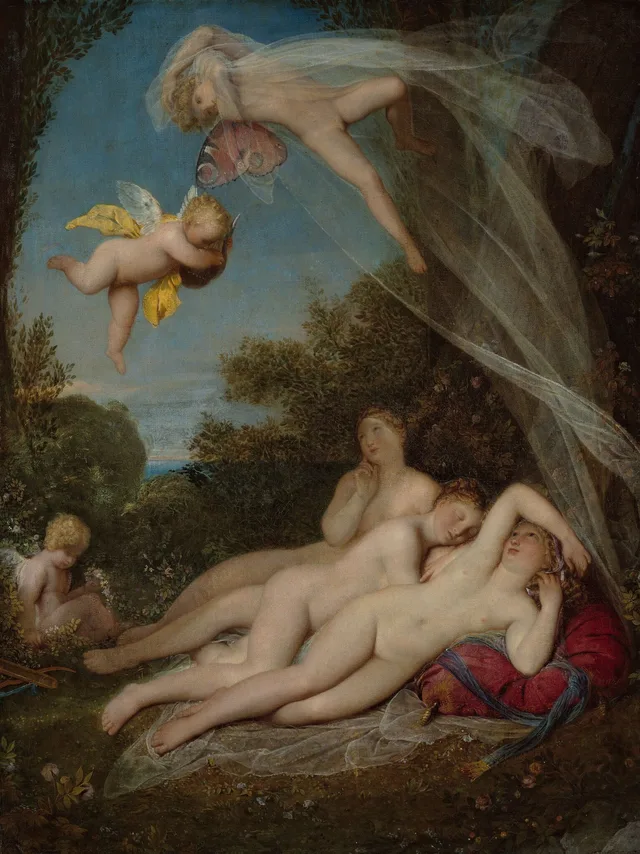
Bruni painted The Awakening of the Graces in Rome in 1827 for Prince Grigory Gagarin, a Russian envoy and collector. The ancient Graces embodied beauty and charm and accompanied Olympian gods. The unusual subject of their repose joins the study of the nude, mythological learning and sensual visual pleasure within a private commission.
Three figures recline together at different stages of waking: one still asleep, another barely opening her eyes, a third rising. Distributing these states allows Bruni to vary bodily turns while preserving the group’s continuity. The subject offers an academic painter different poses within a unified arrangement.
The winged figure above lifts a transparent covering. The museum identifies him as Morpheus, god of dreams. His movement explains the passage from sleep to waking and connects the reclining group to the upper canvas. Myth supplies a cause for the action and a broad airy diagonal above the bodies’ weight.
A small winged Cupid flies nearby. Such companions connect the Graces with Venus and love, helping a classically educated viewer identify the scene. Its attraction did not depend entirely on learning. The airborne pose and pale body against the sky communicate lightness directly.
Roses lie among fabric and foliage in the foreground. Alongside the Cupids, they support the association with Venus. Their meaning belongs to this particular mythological tradition and its history of representation. They also enrich the lower edge with colour and make the resting place appear soft and sumptuous.
Red and blue fabrics set off bare skin and unify the lower group. Flowing bodily contours continue into folds. In Italy, Bruni’s daily artistic practice included studying antiquity and the Renaissance. That training appears in his organisation of varied poses into an easy visual passage from one figure to another.
Early nineteenth-century sculptors and painters, including Canova and Thorvaldsen, renewed interest in the Graces. Bruni contributed a reclining scene instead of the familiar standing group. Ancient myth continued through modern patrons, whose resources, education and tastes helped determine which versions acquired a new material form.
More works by Fyodor Bruni
- Medium
- Oil on canvas
- Collection
- State Tretyakov Gallery
- Dimensions
- 99.5 × 75.1 cm
- Accession number
- Инв.9267
Sources
Public-domain artwork. Digital reproduction from the State Tretyakov Gallery. Image licence