Cupid and Psyche
Jacques Louis David · 1817
Explore the painting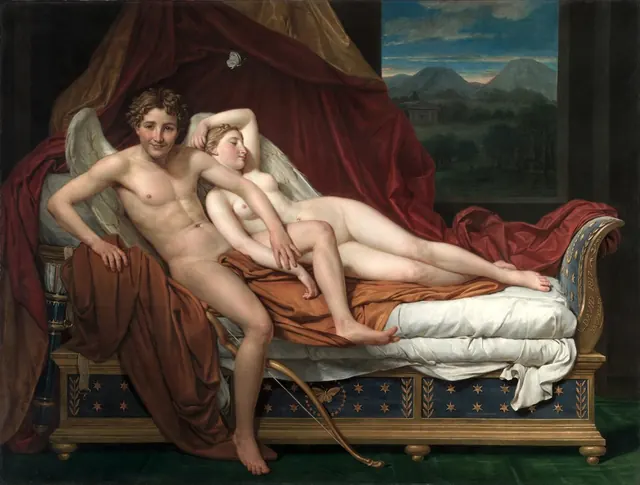
The painting’s story and details
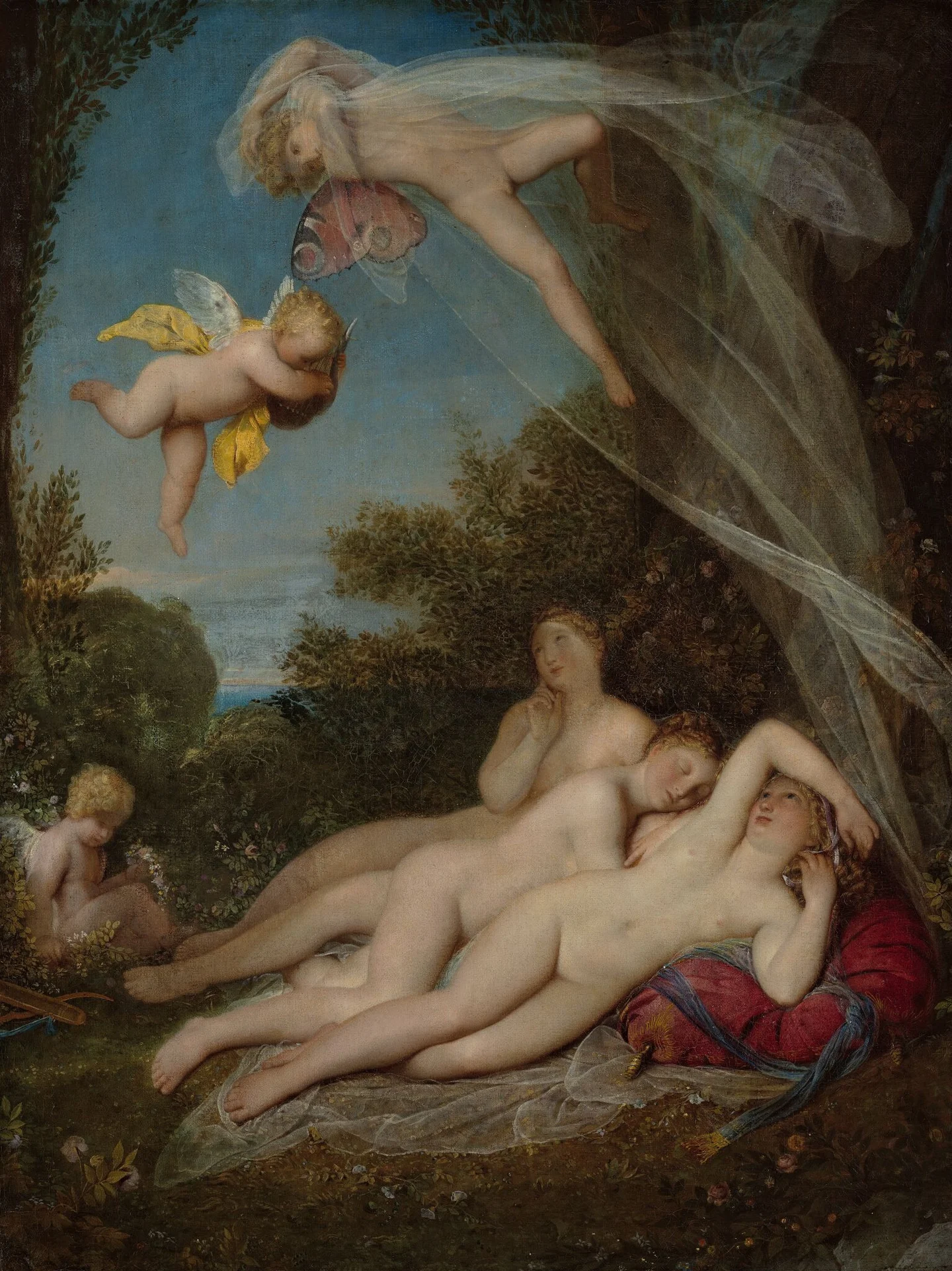
Cupid looks at the viewer with a smirk while Psyche sleeps. Jacques-Louis David completed this painting in Brussels in 1817, having been banished after the Bourbons returned to power. The commission, however, dated to 1813, when it was placed by the Italian collector Giovanni Battista Sommariva. David began the work before his exile, continuing his longstanding interest in ancient stories. Here the beautiful Psyche lies beside her lover’s mocking face, an unexpected combination for a grand mythological painting.
Cupid’s ruddy face turns directly towards us. His mouth curls upwards, his hair is curly, and his gaze is lively. There is little of the solemn detachment one might expect from an ancient deity. The Cleveland Museum connects the image with a poem by Moschus that describes Cupid as mischievous and deceitful. Antiquity offered artists a range of models, including mocking, troublesome characters capable of disturbing the decorum of a mythological painting.
Psyche sleeps with one arm raised above her head. In the myth, Cupid visited her at night and concealed his identity. David reveals to the viewer what she does not yet know: her lover’s wings and face. Psyche’s pale skin and extended pose fit an idealized image of a sleeping beauty. Beside her calm face, Cupid’s smirk becomes particularly conspicuous. David carefully renders both faces, emphasizing the difference between Psyche’s serenity and Cupid’s sly expression.
One of Cupid’s feet is already lowered towards the floor, while his other leg remains bent on the bed. The figures’ arms overlap, making his movement awkward. The Frick Collection interprets him as trying to rise without waking Psyche. Dawn through the window explains the urgency. This small practical difficulty changes the scene’s character: the god must carefully disentangle himself. The grandeur of bed and curtains makes his movement seem all the more earthly.
A white butterfly hovers above Psyche; another appears below, on the front of the bed. In ancient tradition the butterfly is associated with the soul and with Psyche herself. David repeats the sign in two forms, as a living creature and an ornament. Gold stars and plant motifs surround the second butterfly, making it easy to take for decoration alone. The furniture helps tell the story to viewers familiar with its visual conventions.
The bed is painted with almost architectural clarity. Gold trim, blue panels and red curtains create the setting for a luxurious mythological spectacle. The white sheet, however, is crumpled and hangs over the edge. David leaves ordinary traces of use within meticulously arranged decoration. Such choices divided his contemporaries: the Frick’s account notes that some critics saw innovation while others found the painting bizarre. An ancient subject did not guarantee agreement about how it should look.
Cupid seems to invite us to share his smirk. Psyche takes no part in that exchange of looks. We may respond to the comedy or feel uneasy about an alliance between the viewer and the waking figure. This reading rests on who is allowed to look and who remains visible without responding. David preserves the setting’s classical beauty while making our position within the love story less comfortable.
Featured in tours
Love, marriage and encounters
Gods, lovers, spouses and people whose relationships remain unknown.
More paintings to compare
Period, style and subject
- Movement
- Neoclassicism
- Genre
- Myths & allegories
- Medium
- oil on canvas
- Collection
- Cleveland Museum of Art
- Dimensions
- Unframed, 184.2 × 241.6 cm
- Accession number
- 1962.37
Sources
Image provided under CC0. Image licence