Siberian Beauty
Vasily Surikov · 1891
Explore the painting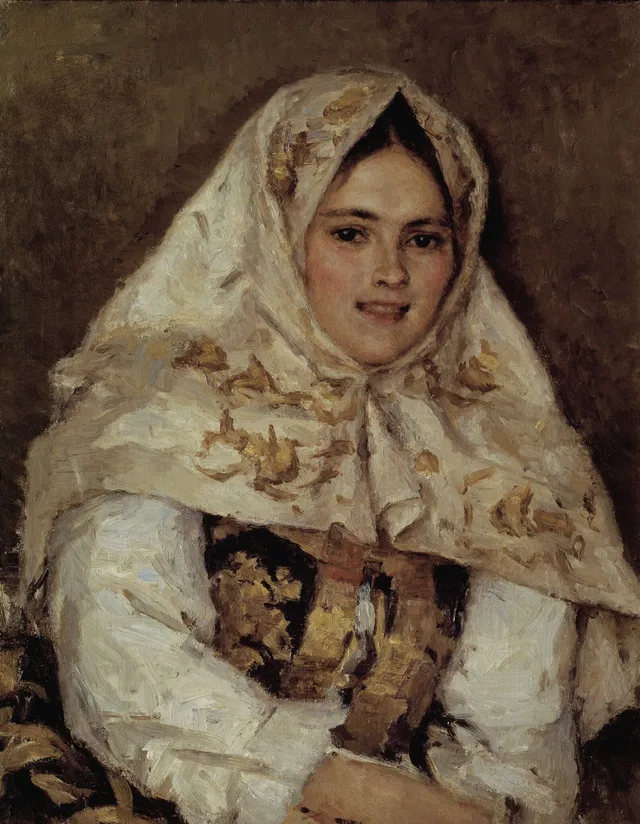
The general title Siberian Beauty conceals a specific woman. Ekaterina Rachkovskaya was a teacher involved in a Krasnoyarsk orphanage and girls’ school. Surikov knew her family and painted this portrait in 1891. Her name and activities reveal a contemporary woman with a public life of her own behind the richly dressed image.
Her slightly turned face meets our gaze. Rachkovskaya had posed for a study for Boyarynya Morozova and served as a model for Taking a Snow Town. One face could belong to historical drama, popular festivity and an independent portrait. Surikov found material for the past among people he knew in the present.
The pale patterned shawl frames her head and covers her hair. Surikov often used this arrangement in portraits of women. It concentrates attention on the face while lending festive dignity. The shawl occupies almost more space than the head itself, making clothing an active part of the portrait alongside facial features.
The golden pattern on dark fabric echoes the shawl. Shared colours connect different surfaces without erasing the distinction between heavier clothing and lighter cloth. Beauty emerges from practical painterly decisions. Close inspection reveals individual strokes, loosening the ornament into something more lively than a mechanically recorded decorative grid.
A broad pale sleeve forms a sweeping curve. Her hands nearly disappear among the lower folds, and no professional object identifies her work. The portrait preserves her face while selecting one aspect of her identity. The teacher and civic participant appears chiefly through an ideal of beauty especially meaningful to Surikov.
The brown background contains almost no objects. It brings the pale silhouette forward and removes the portrait from any identifiable room. Surikov’s contemporary Mikhail Nesterov observed that he saw people as characters who could inhabit different centuries. The removal of everyday surroundings helps explain how that impression is achieved.
The title offers a type; the museum history restores Ekaterina Rachkovskaya’s name. Both ways of viewing the portrait can coexist. One reveals Surikov’s artistic interests, while the other reminds us how much a person exceeds a chosen image. Behind the shawl and festive costume is a woman who taught, supported children and participated in her city’s life.
More works by Vasily Surikov


- Medium
- Oil on canvas
- Collection
- State Tretyakov Gallery
- Dimensions
- 52 × 41.2 cm
- Accession number
- Инв.11183
Sources
Public-domain artwork. Digital reproduction from the State Tretyakov Gallery. Image licence