Daniel Crommelin Verplanck
John Singleton Copley · 1771
Explore the painting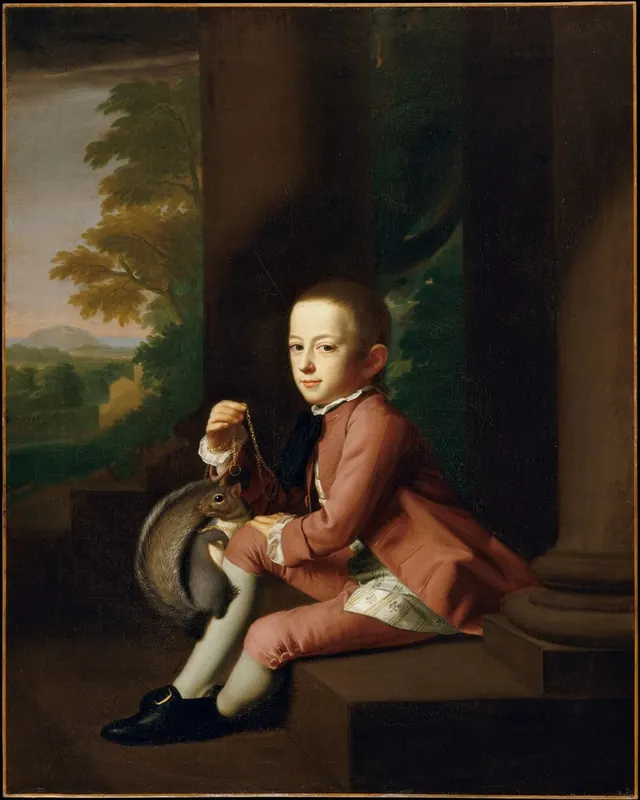
The painting’s story and details
Daniel Crommelin Verplanck is nine. In 1771 John Singleton Copley paints him with a tame squirrel, against the setting of the family estate, Mount Gulian in the Hudson Valley. His parents, Samuel Verplanck and Judith Crommelin, belong to prominent families of Dutch origin. The clothes, pet and imposing column already give the child the standing of a proprietor. Curator Carrie Rebora Barratt connects this image with his father’s wish to present a worthy heir. The portrait shows how adult expectations can enter a picture of childhood.
The boy’s raised hand holds a gold chain. It leads down to the squirrel’s collar, with the slack looping near his fingers. In portraits of this kind a trained pet could stand for the owner’s patience and diligence. Getting an animal to sit quietly nearby required time and familiarity with people. The painting presents the result as already achieved. It invites viewers to judge the boy’s upbringing through his treatment of a creature smaller and weaker than himself.
The squirrel presses close to the boy’s legs, its long furry tail curving upwards. The short hairs on its face and paws differ from the smooth stockings. Beside them Copley paints the chain’s shining metal and the soft skin of the fingers. Such distinctions make the small encounter convincing. It can suggest both care and control. The animal is kept close to its owner, and the chain determines how far it can move away.
The pink suit opens over a pale patterned waistcoat. The sleeves gather into folds, with white cuffs appearing at the wrists. Copley built his career painting prosperous residents of Boston and New York. His patrons valued English taste, often encountered through prints. Portraits like these hung in domestic halls and parlours among fine furniture and tableware. Carefully painted clothing helped present the family’s standing to visitors.
The face turns towards us although the body faces sideways. Large eyes, small lips and a rounded cheek retain the child’s age. Dark architecture rises steeply behind him. The contrast makes the small figure particularly noticeable within the adult setting he has been given. The column could frame an important public figure. Here a boy sits at its base, his public life still ahead of him.
A distant landscape appears between the trees at the left. Verplanck would retain his connection with the family home, where he died in 1834. In the meantime he received private tuition, graduated from Columbia College in 1788 and entered law and banking. From 1803 to 1809 he represented New York in Congress as a Democratic Republican. The American Revolution came between this childhood portrait and that career. His public office belonged to an independent republic.
Copley left for Europe in 1774 and continued his career in London. His American portraits remained records of society before independence. This one makes the difference between biography and expectation especially clear. We know what Verplanck became; the patron did not. He could provide his son with education, inheritance and an image of a worthy future. The squirrel, suit and column make those family hopes visible long before Daniel’s first political decision.
More paintings to compare
Period, style and subject
- Movement
- American painting
- Genre
- Portrait
- Medium
- Oil on canvas
- Collection
- The Metropolitan Museum of Art
- Dimensions
- 125.7 × 101.6 cm
- Accession number
- 49.12
Sources
Image provided under CC0. Image licence