Watson and the Shark
John Singleton Copley · 1778
Explore the painting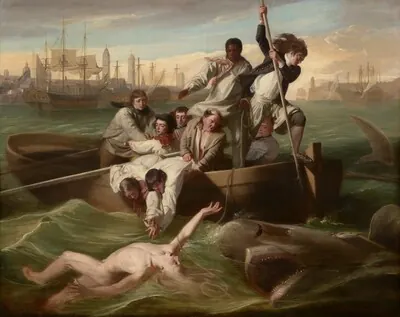
The painting’s story and details
In 1749, a shark attacked fourteen-year-old Brook Watson in Havana harbour. Sailors rescued him, but his right leg had to be amputated below the knee. Almost thirty years later, Watson, now a successful British merchant, commissioned Copley to paint his rescue. The artist chose seconds when the outcome still seems uncertain. We know the boy survived, yet still wait to see whether the men can reach him.
Watson’s nude body stretches across the foreground. Pale skin stands out against dark water, and his right arm reaches towards the boat. A wave hides the injured part of his leg. The painter emphasizes a person’s vulnerability before danger. The figure’s large scale brings the event close, as though we stood at the water’s edge watching the rescue from only a few steps away.
Two sailors lean over the side. A small gap remains between their hands and the boy’s. Others steady their companions and the boat. Rescue becomes a chain of mutual support that no single person could complete. Copley connects the figures so that our eye passes from one pair of hands to another before returning to the most dangerous gap above the water.
The sailor at the bow has raised a boat hook. His legs brace against the boat, his body turns towards the shark, and the shaft crosses almost the picture’s full height. His pose creates a forceful downward direction towards the jaws. Previously known for portraits, Copley used the possibilities of a large multi-figure scene. A real event from the recent past acquired a scale traditionally associated with historical and biblical subjects.
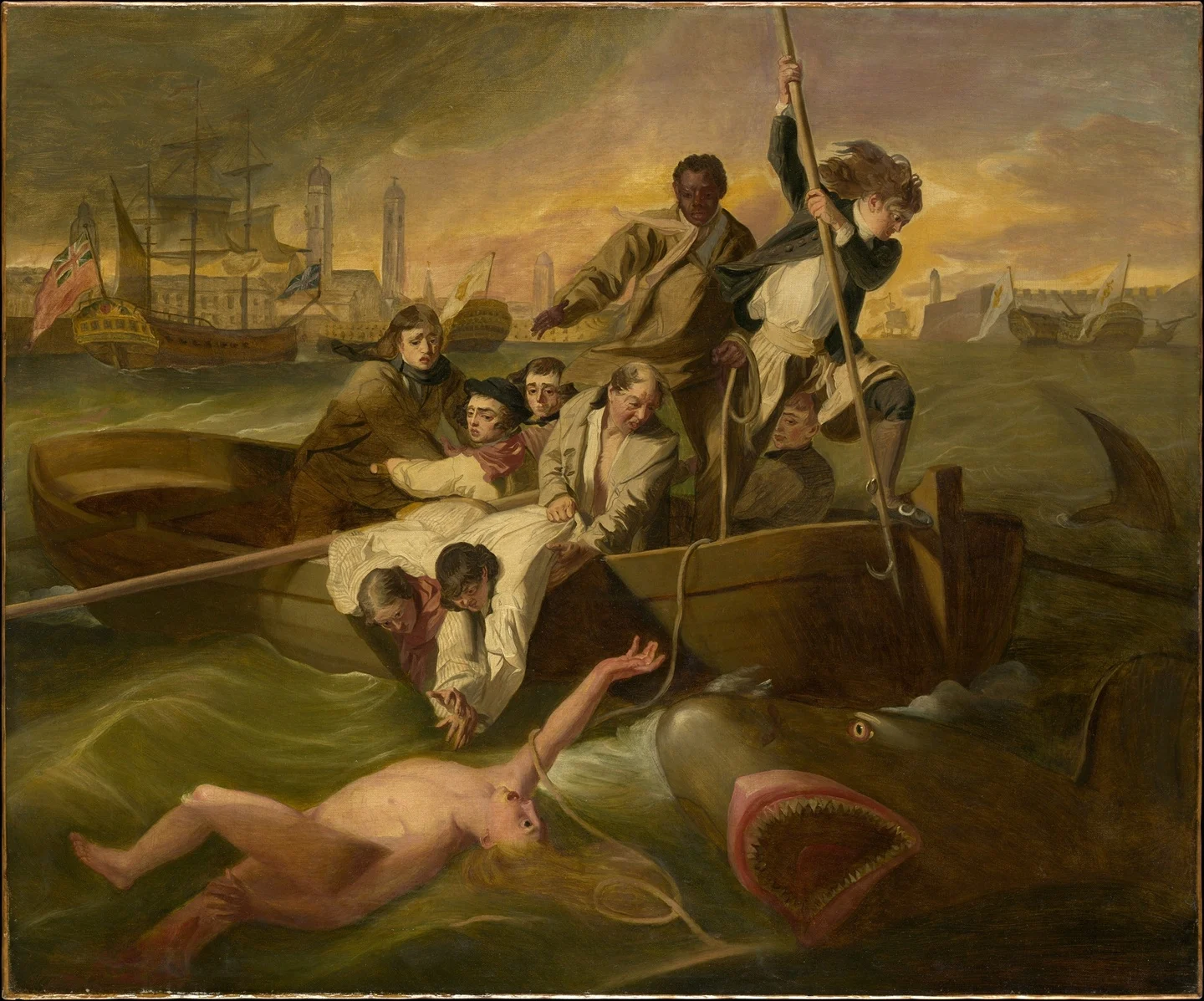
The Black sailor holds the rope and extends his hand towards Watson. In a preparatory drawing this figure was white; Copley deliberately changed it. His name and legal status remain unknown. The museum draws attention to the harbour’s connection with colonial commerce and slavery. Against that background, a man of African descent helping save a white boy carries particular weight. His own story remained outside the painting’s title.
The shark opens its mouth close to the boy. Eye and teeth are sharply rendered, but its anatomy is inaccurate. Copley had not witnessed the attack and constructed the scene many years later. The predator shows how history painting works. An event gains conviction through composition and recognizable actions, even when some reconstructed details depart from accurate observation.
Watson bequeathed the painting to the charitable school Christ’s Hospital, hoping it would provide a useful example for the young. His will records that intention. Yet the image has several possible centres. For the patron, his own rescue was central. Today we can look more closely at the unnamed people who made it possible and the trading harbour behind them. One man’s story of survival also becomes a history of people scarcely preserved in the record of his life.
More paintings to compare
Period, style and subject
- Movement
- Neoclassicism
- Genre
- History painting
- Medium
- oil on canvas
- Collection
- National Gallery of Art, Washington
- Dimensions
- Overall, 182.1 × 229.7 cm
- Accession number
- 1963.6.1
Sources
Reproduction of a public-domain artwork. Image licence