Edward and Sarah Rutter
Joshua Johnson · ca. 1805
Explore the painting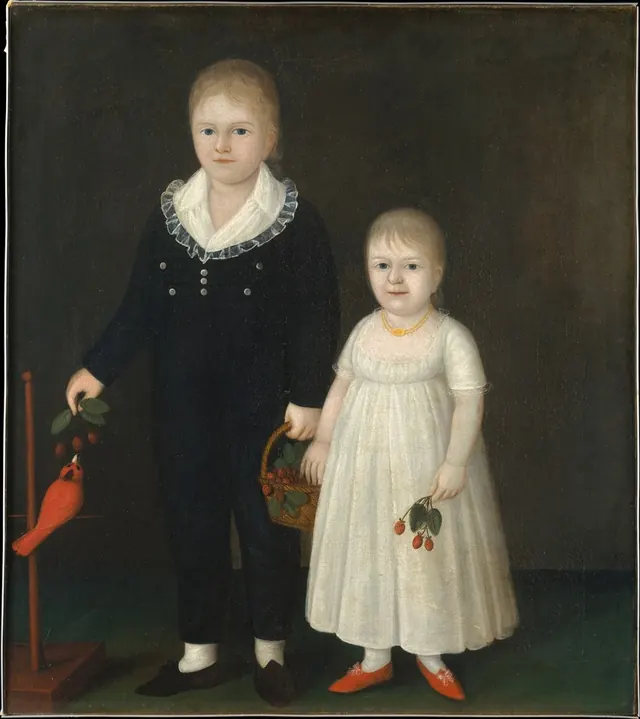
The painting’s story and details
Edward and Sarah were the children of Baltimore captain Joshua Rutter and Mary Pennington Rutter. Around 1805 they were painted by Joshua Johnson, the earliest known African American to earn a living as a professional portraitist. Born into slavery, he gained freedom and worked for families in the trading city. Such a commission preserved the children’s likenesses and displayed a household’s means.
Edward stands almost directly before us. Small pale buttons and a fine collar frill show clearly against his dark suit. Johnson describes these small features carefully while leaving the broad clothing surface almost even. The eye therefore meets the child’s face first, then moves down towards his occupied hands and the bright bird.
Sarah stands close beside her brother in a pale dress. Fine vertical folds lengthen her figure, and short sleeves leave her arms exposed. A golden ornament appears at her neck. White fabric and the black suit form two large neighbouring areas, allowing the smaller figure to remain as prominent as the taller one.
On the left, a red bird reaches towards the berries Edward holds. Its perch identifies it as a kept bird. The action introduces a small feeding episode into the formal arrangement. The boy’s hand, berries and upturned head make a clear sequence: an everyday activity can be read directly from the objects and gesture.
A woven basket of berries and leaves sits between the children. Edward holds its handle, while Sarah’s hand rests at its edge. The basket joins the figures at hand level. Its weave is described with careful intersecting lines, although floor and background are almost bare. Objects the children touch receive particularly close attention.
In her other hand Sarah holds strawberries on their stems. The red fruit repeats the colour of the bird and shoes, distributing bright accents across the lower portrait. Fruit and flowers recur in Johnson’s commissions. They belonged to a familiar repertoire of family-portrait props that occupied a sitter’s hands and connected neighbouring figures.
Red-orange shoes with pale bows appear beneath the hem. Beside them are her brother’s black shoes and white stockings. Their feet share a dark floor but cast little visible shadow. Johnson gives objects clear outlines while keeping space shallow. That flatness later attracted artists and collectors in the early twentieth century.
In a newspaper advertisement of 1798 Johnson described himself as self-taught and mentioned obstacles to pursuing his profession. City directories list him as a portrait painter and, in 1817, among free Black householders. His career developed in a society that retained slavery. Behind this composed family image lies an artist who established an independent profession after emancipation.
Featured in tours
Portraits. How people presented themselves
Rulers, merchants, artists and private patrons before a viewer.
More paintings to compare
Period, style and subject
- Movement
- American painting
- Genre
- Portrait
- Medium
- Oil on canvas
- Collection
- The Metropolitan Museum of Art
- Dimensions
- 91.4 × 81.3 cm
- Accession number
- 65.254.3
Sources
Image provided under CC0. Image licence