George Washington
Gilbert Stuart · begun 1795
Explore the painting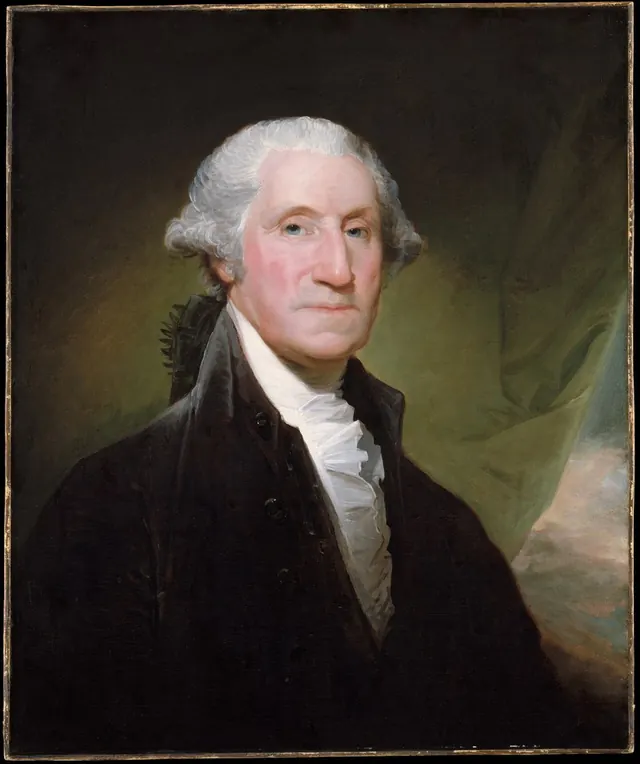
The painting’s story and details
Stuart began this portrait in 1795, during Washington’s presidency. The new republic’s visual language was still taking shape, and its elected leader needed a recognisable official image. The painting belongs to the Vaughan group, named after an early version’s owner. Stuart repeated the arrangement for different patrons, carrying the same face far beyond those who personally knew the president.
The head turns slightly right while the eyes meet us. Pink areas on the cheeks sit beside cooler shadows near nose and chin. Stuart preserves facial asymmetry and the weighty line of the mouth. A living appearance becomes stable enough to repeat without reducing skin to one colour or contours to perfect regularity.
Pale hair stands out around forehead and ears. Washington wore his own hair, dressed and powdered in the fashion of the period. A dark ribbon behind his neck secures the style. Its whiteness contrasts strongly with green background and black clothing. This familiar feature belongs to grooming practice as well as the sitter’s age.
The white cravat and shirt ruffles form a pale strip beneath the face, their sharp edges visible against the dark collar. This is formal civilian dress suited to the presidency. It preserves the dignity of a state portrait without military uniform, crown or sash. Position is conveyed through restrained clothing and the presentation of the head itself.
Examination of the paint revealed an earlier coat. It was initially brown, representing American wool broadcloth; Stuart then changed it to black fabric resembling European silk velvet. Washington wore such a suit on official occasions. The revision adjusted the image’s degree of formality, showing how much political portraiture could communicate through clothing material.
Green drapery descends behind the shoulder, leaving a small patch of pale sky on the right. It is a conventional formal setting rather than a detailed office. Light changes more softly in its folds than on the white shirt. The green surface separates the pale head from deep shadow and softly surrounds the black collar.
Sittings in 1795 and 1796 gave Stuart the basis for several Washington portrait types. Repetitions met demand for the image of a man who embodied the new state. Here the choice between local wool and costly European velvet is particularly revealing. The republic built its own signs of authority while continuing to use some habits and artistic resources of European society.
More paintings to compare
Period, style and subject
- Movement
- American painting
- Genre
- Portrait
- Medium
- Oil on canvas
- Collection
- The Metropolitan Museum of Art
- Dimensions
- 76.8 × 64.1 cm
- Accession number
- 07.160
Sources
Image provided under CC0. Image licence