The American School
Matthew Pratt · 1765
Explore the painting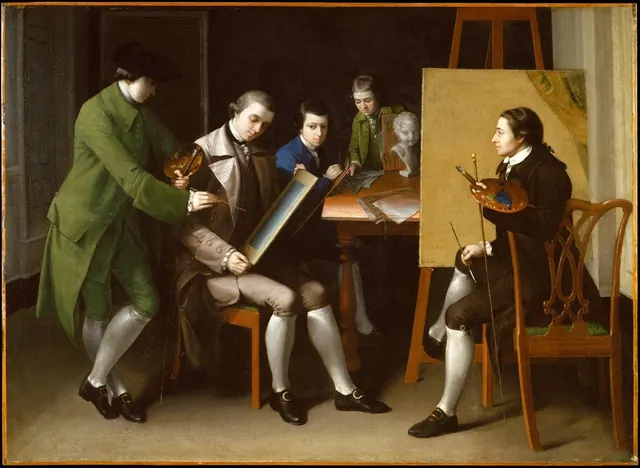
The painting’s story and details
In 1765, an American school of art could still be located in London. Matthew Pratt depicts a circle of painters from the colonies in Benjamin West’s studio. American independence lay eleven years ahead. The title groups these artists by their origins, while their activities connect them with European academic training. Learning abroad forms part of the beginnings of an independent American art.
The man in the green coat on the left is generally identified as West. Holding a palette, he addresses the seated draughtsman. His upright figure and extended hand place him at the centre of the exchange. Yet Pratt left no reliable list identifying everyone present. Some names in this professional circle have to be reconstructed from indirect evidence.
The seated man has a large drawing board across his knees. His activity differs from the painter’s work at the easel on the right. Pratt brings different stages of training into one room. Drawing required fewer materials and allowed students to practise proportion and the construction of form before introducing the additional complexity of oil paint.
Two younger figures gather at the table. One turns towards us, while the other bends over his work. Their heads form a close group, but their gazes lead in different directions. This keeps the scene looking like a lesson in progress. A shared studio offered opportunities to observe another person’s work and compare it with one’s own; the painting makes that process visible.
Scholars identify the painter at the easel as Pratt by comparing his face with self-portraits. He presents himself with palette and brushes, apart from the younger artists drawing nearby. This arrangement establishes his professional standing. The picture’s maker places himself within the American community while also asserting his own level of accomplishment within it.
A large pale canvas occupies much of the right side of the room. A coloured passage appears near its upper corner; we see its front, with a large, almost uniform field. Its size lends importance to the painter’s activity. The image on it is barely indicated and does not compete with the people in the studio. Brushes, palette and easel represent the work through its tools.
A small sculpted head on the table points to the use of study models. Sheets and drawing materials lie nearby. Academic training relied on repetition, comparison and work with existing examples. Classes required a room, models and tools. These objects formed the aspiring artist’s everyday surroundings.
Pratt exhibited the canvas at London’s Society of Artists of Great Britain in 1766. The studio community became a public statement. Later accounts tied the picture closely to West’s fame, pushing its maker into the background. Yet Pratt appears here as a practising painter. The work raises a question about how one celebrated member’s reputation can reshape the memory of an entire group.
Featured in tours
Portraits. How people presented themselves
Rulers, merchants, artists and private patrons before a viewer.
More paintings to compare
Period, style and subject
- Movement
- American painting
- Genre
- Everyday life
- Medium
- Oil on canvas
- Collection
- The Metropolitan Museum of Art
- Dimensions
- 91.4 × 127.6 cm
- Accession number
- 97.29.3
Sources
Image provided under CC0. Image licence