Dance in a Subterranean Roundhouse at Clear Lake, California
Jules Tavernier · 1878
Explore the painting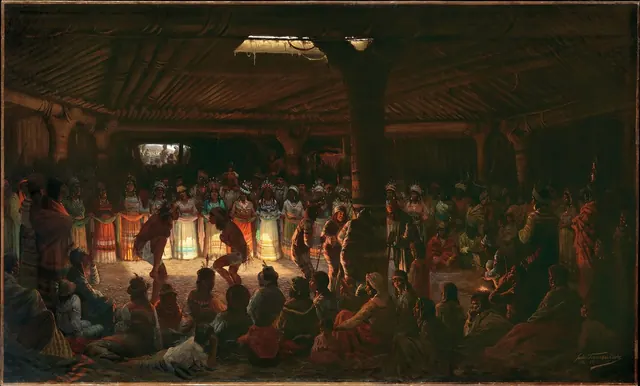
The painting’s story and details
In 1876 several wealthy European visitors attended an Elem Pomo ceremony at Clear Lake in California. Banker Tiburcio Parrott commissioned Jules Tavernier to commemorate the visit. The artist finished the painting two years later. For the guests it was a rare spectacle; for the community, a ceremony connected with its continued existence.
Dancers occupy the lit space inside a circle of people. The ceremony is called mfom Xe, or “people dance.” Community member Robert Joseph Geary explains that it emerged after contact with settlers, when violence and disease threatened the people’s survival. Adults and children acted together to protect the people and the land.
Massive posts and crossbeams support the roof. Light enters from above and through a small opening at the back. Tavernier keeps the foreground in shadow and concentrates brightness around the dance. The arrangement reveals the structure of the partly subterranean roundhouse and the density of the gathering inside.
Behind the dancers stand women in pale clothing with bright bands. Nearer us, seated people turn their backs or sides and overlap one another. Almost a hundred figures occupy the painting. Performers, musicians, children, and spectators form a complex social space, with different groups maintaining a shared circle despite the crowding.
Tavernier included his patron Parrott, Baron Edmond de Rothschild, and Count de Turenne among those present. Admission itself was a privilege. The painting commemorated the exceptional access available to wealthy travelers, while the people conducting the ceremony remained its principal actors.
The commission had a troubling counterpart. Parrott operated a mercury mine on Elem Pomo ancestral land. Contamination outlasted the mine itself. The US environmental agency’s cleanup encompasses the mine, residential soils, and lake sediments. The man who financed the community’s image participated in an enterprise that damaged its living conditions.
Robert Joseph Geary notes that the painted building accords with accounts passed down by elders. The ceremony and roundhouse continue within the community. This changes how an old painting of an Indigenous people can be understood. The people shown have descendants who sustain the tradition and explain its meaning in their own words.
Featured in tours
American landscape. Land and its inhabitants
Nature, territorial expansion, the Civil War and urban life in American painting.
More paintings to compare
Period, style and subject
- Movement
- American painting
- Genre
- Everyday life
- Medium
- Oil on canvas
- Collection
- The Metropolitan Museum of Art
- Dimensions
- 121.9 × 183.5 cm
- Accession number
- 2016.135
Sources
Image provided under CC0. Image licence