Madonna and Child
Giovanni Bellini · late 1480s
Explore the painting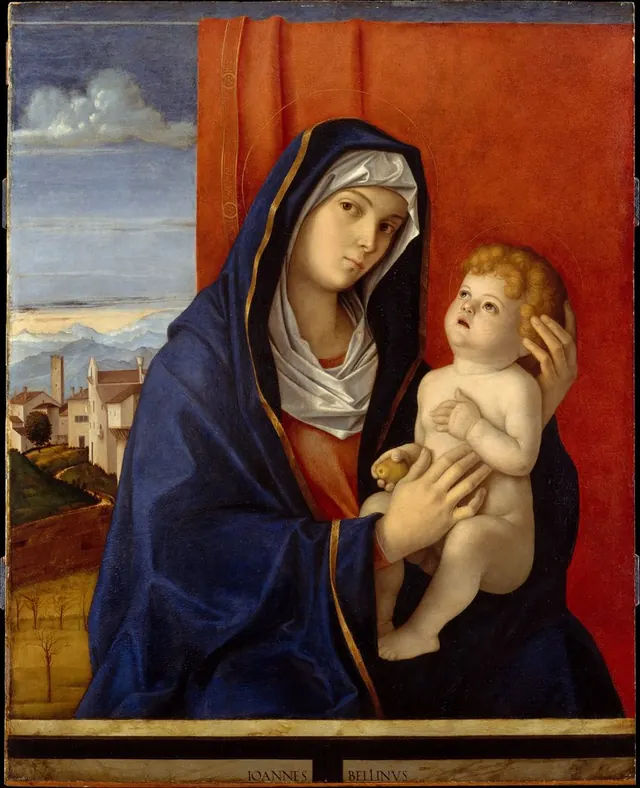
The painting’s story and details
Bellini places the Virgin and Child close to the viewer, with a stone parapet between them. Painted in oil on wood in the late 1480s, the sacred figures have weight, soft skin, and substantial drapery. The red textile behind Mary also marks her position, much as a cloth of honor would distinguish an important person.
Mary looks outward toward the viewer. Her head inclines slightly, but her eyes do not follow the child’s movement. The group thus has two directions of attention. The child turns within the picture while Mary addresses the space beyond it. Her face establishes an encounter before the surrounding landscape comes into focus.
The child tips his head back while Mary’s hands support his body. Bellini joins skin tones through gradual transitions. Contours remain clear, but light passes gently into shadow within them. Volume emerges without harsh internal lines. The child appears mobile and substantial enough to make the mother’s supporting gesture essential to the composition.
Mary’s fingers rest against the child’s body beside converging blue, red, and pale fabrics. The broad blue mantle connects her figure to the lower edge. The red cloth behind her conveys little sense of a room’s depth. Tangible human volume coexists with a flat field of color, preserving the formality of the sacred image.
At the left, the cloth opens onto a distant landscape. Bare branches coexist with green slopes and a brightening sky. The Metropolitan Museum reads the passage from barrenness to growth and from night toward morning as a reference to Christ’s death and resurrection. This interpretation connects the apparently peaceful view to the child’s future.
Bellini’s name appears on the stone parapet, its dark letters clearly set against a pale surface. The signature preserves the maker’s identity within a sacred image. Veneration of Mary and Christ coexists with recognition of a particular artist whose manner and name could matter to the painting’s owner.
The composition is deliberately asymmetrical. Figures and red cloth occupy the right, while an open landscape lies at the left. Formal veneration joins the experience of close human presence. The infant can be seen as a child in his mother’s arms, while the surrounding signs connect the encounter to the Christian narrative. Both possibilities remain available to different viewers.
Featured in tours
Christian images. From mosaic to Caravaggio
Icons, manuscripts, domestic devotional pictures and church altarpieces.
More paintings to compare



Period, style and subject
- Movement
- Renaissance
- Genre
- Religious art
- Medium
- Oil on wood
- Collection
- The Metropolitan Museum of Art
- Dimensions
- 88.9 × 71.1 cm
- Accession number
- 08.183.1
Sources
Image provided under CC0. Image licence