Portrait of a Young Man in Red
Giovanni Bellini · c. 1480
Explore the painting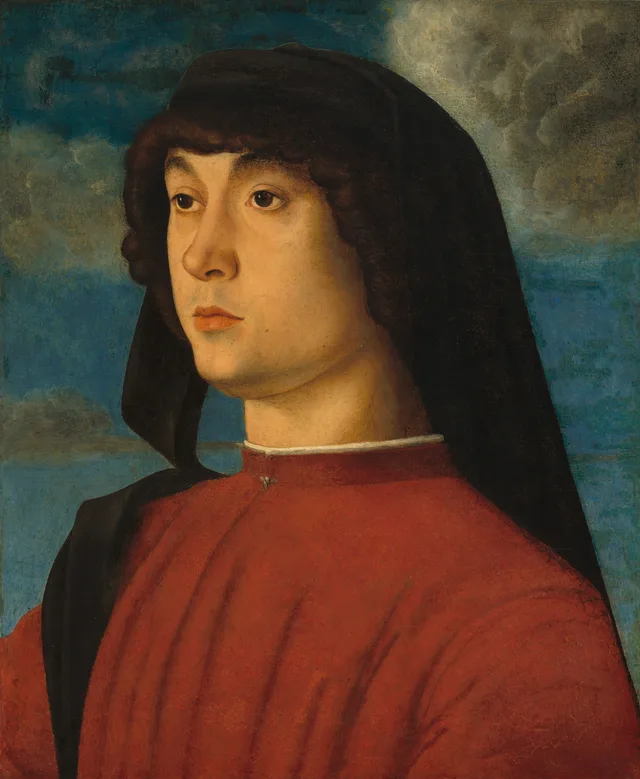
Bellini painted this young man around 1480. His identity has not survived. Only about thirty-two centimeters high, the portrait invites close viewing. Cloudy sky replaces a wall behind his head, giving the figure space of his own, although neither profession, family position, nor a particular location is specified.
The face turns three-quarters toward us. We see the nose’s profile, the farther cheek, and both eyes. Light passes gently into shadow, giving the head volume. Bellini combines a distinct silhouette with gradual changes in flesh tones. For Venetian painting, such handling of color became a central means of making bodies convincingly present.
The broad red garment fills almost the entire lower half of the painting. Folds descend from the neckline, suggesting the shoulders and chest beneath. There is no insignia or coat of arms. Rich colour, broad shoulders and a restrained pose create a dignified appearance. Chosen clothing presents the sitter even without explicit signs of his occupation.
The black head covering encloses the hair and falls in long ends at either side. Sky makes its outline especially distinct. Darkness beside the lit cheek heightens its warmth. Replacing the black with pale cloth in imagination changes how the face appears. Portrait likeness depends partly on relationships outside the face itself.
At the throat, a narrow white strip of shirt and a tiny fastening interrupt the red. This precision balances the broad areas of color. Attention can move from the overall silhouette to the construction of an everyday object. In a small portrait, such details reward close viewing and sustain the figure’s presence without becoming an inventory of possessions.
The clouds are painted more freely than the facial features. Air surrounds the sitter without suggesting a particular walk or journey. The sky’s cool tones separate warm flesh from the background. Comparing this portrait with one set against black reveals how strongly surroundings affect the encounter between sitter and viewer.
Bellini worked in Venice, where portraiture existed alongside major church commissions. Depicting saints and contemporaries could call on related skills in light, posture, and the positioning of a head. This youth nevertheless remains a person without a known biography. His image raises the question of how much individuality survives when a name, conversations, and relationships with the patrons have disappeared.
More works by Giovanni Bellini

- Medium
- oil and tempera on panel
- Collection
- National Gallery of Art, Washington
- Dimensions
- 32 × 26.5 cm
- Accession number
- 1937.1.29
Sources
Museum reproduction. Public domain, NGA Open Access. Image licence