The Square of Saint Mark's, Venice
Canaletto · 1742/1744
Explore the painting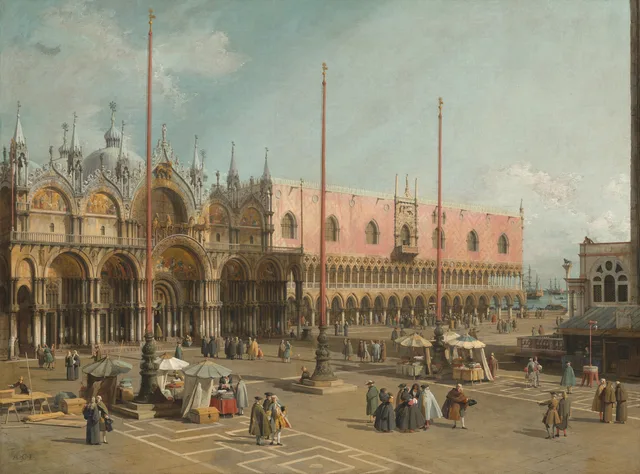
Saint Mark’s Basilica and the pink Doge’s Palace rise behind a square filled with people and market stalls. Canaletto painted the view around 1742–1744. British travelers were particularly eager buyers of his Venetian scenes. This picture and its companion view of the Grand Canal belonged to the Earl of Carlisle and decorated Castle Howard, recalling travel and displaying cultivated taste.
Arches, domes, and small ornaments articulate the basilica’s façade. It occupies much of the left side, yet sufficient square remains before it to place the building within urban life. People approach, pass, and trade nearby. The monument shares space with everyday activities rather than standing apart from them.
The Doge’s Palace, with its open lower arcades, recalls Venice’s political order. The doge was the republic’s elected ruler. Religious and governmental centers stand together, making the view an image of architecture and authority. For a foreign owner, one place could provide a recognizable representation of the whole state.
Stalls and canopies occupy the square, their small shadows defining volume and bits of bright cloth standing out against stone. Trade belongs within the celebrated view. Monumental buildings share space with temporary structures set up for daily income, making the city seem active rather than arranged solely for admiration.
Figures gather in pairs and small groups to talk, walk, and inspect goods. Up close, faces often consist of a few strokes; at a distance those are enough to suggest variety. People establish the buildings’ scale, while repeated small actions give the broad square a human rhythm.
Pale paving lines extend across the square, joining foreground and façades. Perspective remains clear without becoming a rigid diagram. Shadows beneath people and stalls support the sunny atmosphere. A convincing city view emerges from many small, coordinated decisions that viewers normally experience at once as a single space.
The painting offers a traveler’s Venice while retaining local life. For some the square became an impressive memory; for others it was a workplace and a familiar route. This double perspective makes a veduta, a detailed city view, more than an attractive souvenir. Carried to an English house, it preserved traces of a city living on without its owner.
More works by Canaletto
- Medium
- oil on canvas
- Collection
- National Gallery of Art, Washington
- Dimensions
- 114.6 × 153 cm
- Accession number
- 1945.15.3
Sources
Museum reproduction. Public domain, NGA Open Access. Image licence