Entrance to the Grand Canal from the Molo, Venice
Canaletto · 1742/1744
Explore the painting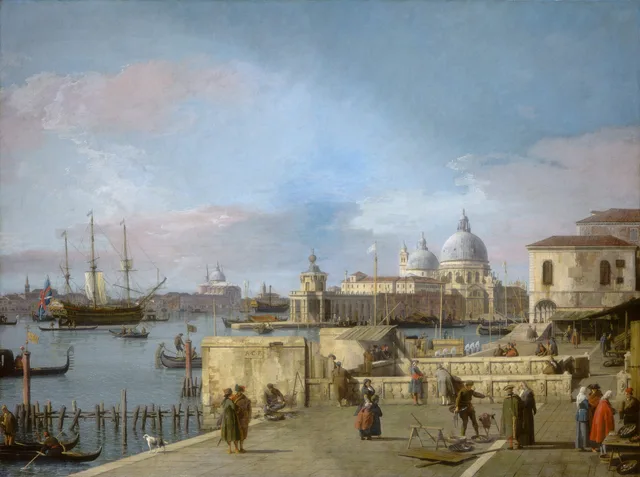
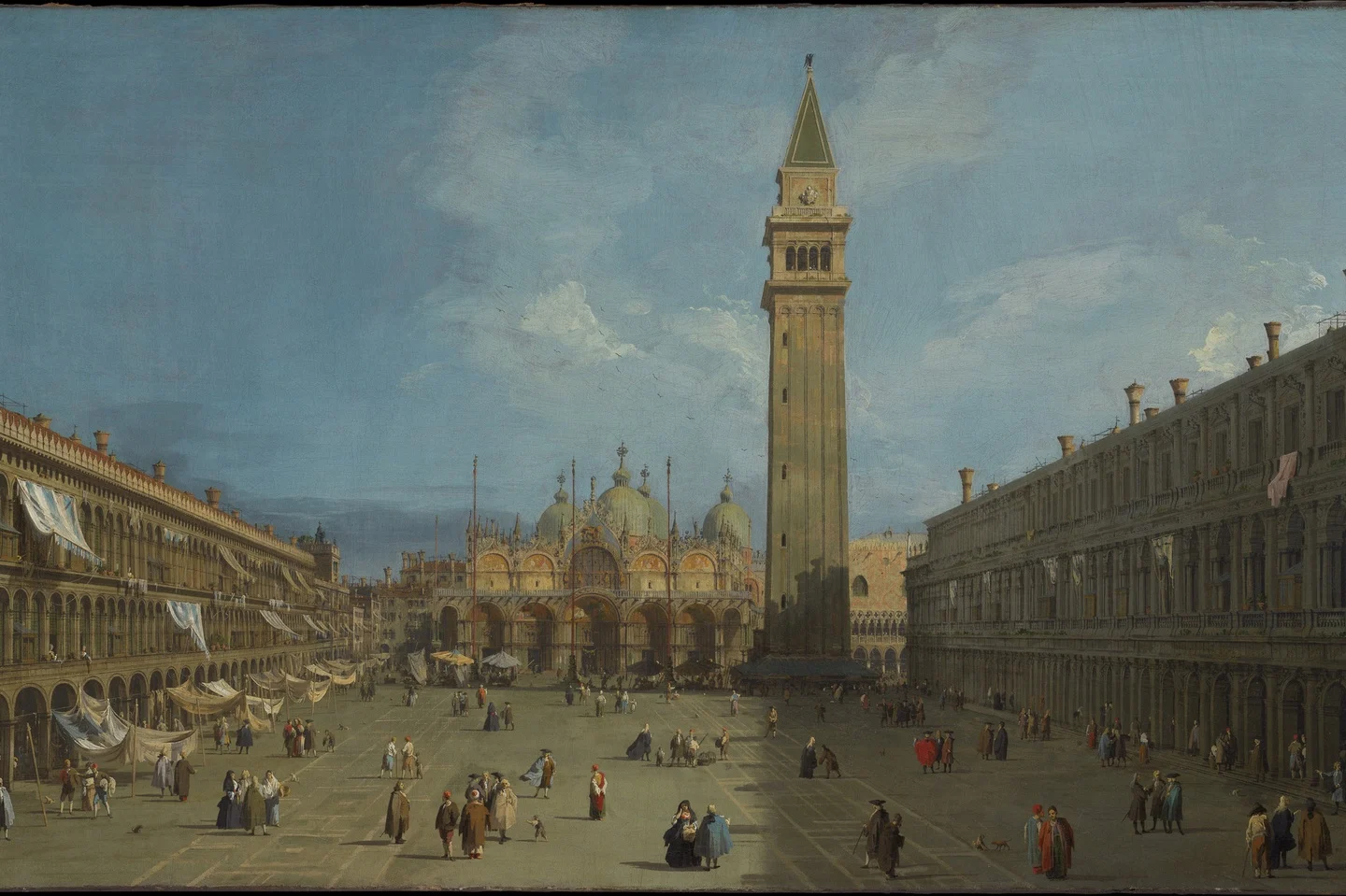
People talk on the quay, boats cross the water, and domes rise beyond. Canaletto painted this around 1742–1744 as a companion to his view of Saint Mark’s Square. The Earl of Carlisle acquired both for Castle Howard. Venice was a major stop on the European educational tour, and a painting offered a carefully selected image of its light, buildings, and daily life.
A large vessel stands among much smaller gondolas. Waterways supported both local movement and distant trade. For Venice the sea was a source of income and a condition of existence. The attractive canal is also a road, port, and workplace. Different vessel sizes make several levels of the urban economy visible together.
The customs house stands across the water, where sea-borne goods were unloaded and taxed. The low building occupies a significant position beside grand churches. Canaletto keeps the city’s financial life within its architectural image. Duties, cargo, and trade regulations helped sustain the Venice admired by foreign visitors.
The two domes of Santa Maria della Salute stand clearly against the sky. Designed by Baldassare Longhena, the church was a major landmark at the canal’s entrance. Rounded forms contrast with the quay’s long line, providing a stable point of recognition among numerous small boats and figures.
On the nearer quay, sellers display fish and passersby pause at stalls. Brief touches distinguish their activities. Canaletto distributes small incidents so the eye continually finds something new. The picture rewards sustained viewing, and its abundance of detail formed part of what a buyer was paying for.
The long pale building and shoreline on the right direct attention into depth. Dark boats alternate with bright intervals of water, keeping movement legible despite abundant detail. A large sky balances the dense urban band below. The active port becomes a clear, readily surveyed whole.
In an English country house, this painting recalled travel and signaled its owner’s cultural experience. Within it, people buy, transport, and trade. The same view holds two histories: a privileged viewer could purchase Venice as a memory, while its inhabitants continued to experience it as a place of daily work.
More works by Canaletto
- Medium
- oil on canvas
- Collection
- National Gallery of Art, Washington
- Dimensions
- 114.5 × 153.5 cm
- Accession number
- 1945.15.4
Sources
Museum reproduction. Public domain, NGA Open Access. Image licence