Olympia
Édouard Manet · 1863
Explore the painting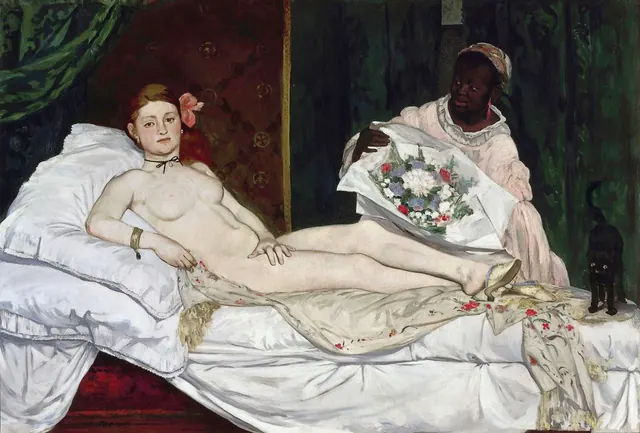
The painting’s story and details
Manet painted Olympia in 1863 and exhibited it at the Salon of 1865. The reclining pose refers to Titian’s Venus of Urbino, but contemporaries recognised a Parisian courtesan. Familiar museum nudity became connected to the financial and social relations of the present. Both subject and technique provoked outrage: abrupt pale areas did not meet expectations of a smoothly modelled ideal body.
Olympia looks straight ahead. A black ribbon at her neck emphasises her skin, while the flower in her hair and jewellery preserve signs of dressing despite her nudity. Her gaze does not turn towards the flowers. It may be directed at someone before the bed, perhaps a visitor. Viewers find themselves in the position of someone being assessed in return.
The hand across her body appears flat and firmly outlined. It blocks the viewer’s access where a conventional gesture of modesty might be expected. This supports a reading of the hand as control over her own body. Her direct gaze strengthens that possible meaning: access to the represented woman remains subject to relationships and conditions. Display and restricted access remain in tension.
A large bouquet enters the room with a servant. The Musée d’Orsay connects it to a gift from an admirer or client. The flowers extend relationships existing beyond the image. They may express courtship while also suggesting material exchange. Manet leaves the sender unseen, so his presence must be reconstructed through an object and the direction of Olympia’s gaze.
The Black woman holds the bouquet and looks at Olympia. The model was called Laure; her name and Paris address survive in Manet’s notebook. Knowing this restores an individuality easily concealed by the role of an unnamed servant. Pale clothing and a dark background establish her compositional position, but an explanation in terms of colour cannot exhaust the second woman’s presence.
A shawl crosses the broad white bed. Pattern, fringe and folds reveal different densities of brushwork. The body beside it uses much flatter pale areas. This contrast makes the painted surface conspicuous. Manet does not try equally everywhere to conceal the brush, and viewers move between represented material and paint itself.
A black cat stands at her feet with its tail raised. Titian placed a sleeping dog there, associated with marital fidelity. The calm of Titian’s bedchamber gives way to the alertness of a contemporary interior. The cat’s alert silhouette interrupts the bed’s long horizontal and adds movement while the main figure remains still.
In 1890 Monet organised a subscription to present the painting to the state. A scandalous work entered the national collection. Its later recognition did not settle questions of looking. Olympia can appear to meet a visitor on her own terms while the image also maintains a hierarchy between its two women. Restoring Laure’s name broadens a discussion long concentrated almost exclusively on the nude body.
Featured in tours
Early Impressionism. Paris 1860–1879
The Salon, the first independent exhibition, railway stations, studios and leisure on the Seine.
World classics. Altar, palace, exhibition
Familiar paintings and the people for whom they were made.
More paintings to compare


Period, style and subject
- Movement
- Realism
- Genre
- The nude
- Medium
- Oil on canvas
- Collection
- Musée d'Orsay, Paris
- Dimensions
- 130.5 × 191 cm
- Accession number
- RF 644
Sources
Reproduction of a public-domain artwork. Image licence