Merrymakers at Shrovetide
Frans Hals · ca. 1616–17
Explore the painting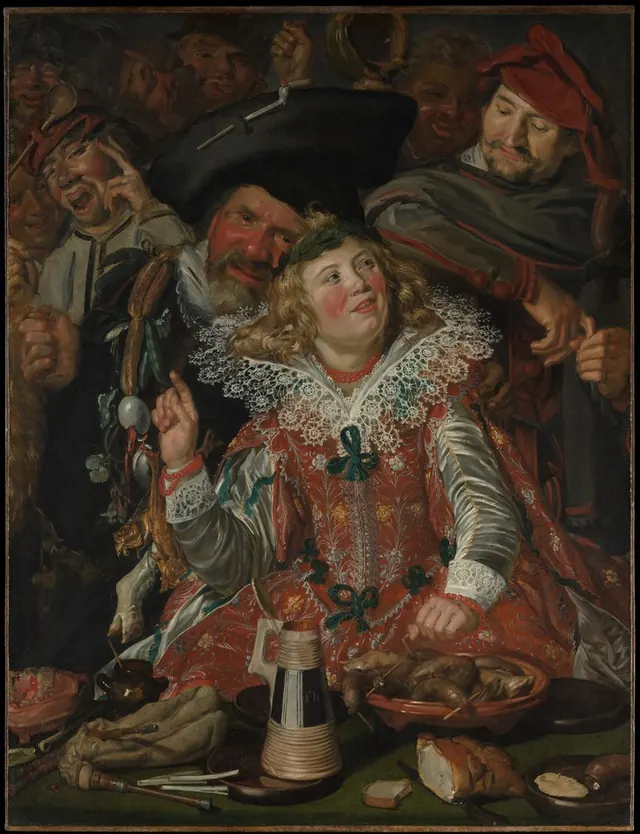
The painting’s story and details
A noisy company crowds behind a table. Frans Hals painted it around 1616–1617, depicting the carnival before Lent. In the Netherlands these festivities were associated with comic performances, including those held by painters’ guilds. Recognizable stock theatrical characters appear here. Their absurd ornaments, edible props and gestures helped audiences identify the roles at once. The painting preserves a world of jokes in which appetite and breaches of decorum were part of the festive performance.
The bearded character in the enormous black hat is Pekelharing, whose name refers to salted herring. Sausages, eggs, fish and a pig’s trotter hang across his chest, turning food into costume decoration. He leans towards the seated figure, almost touching the hair. The hat occupies an absurd amount of space above the lace collar. The scale of objects supports the comic exaggeration just as much as facial expression and the performers’ close proximity.
Hans Wurst leans in from the upper right, another comic type whose name is associated with sausage. His red cap stands out among the darker heads. One hand is near the central figure’s shoulder; the other is clenched at the picture’s edge. Behind him are a raised tankard and open-mouthed faces. Hals leaves very little free background. The company seems close because the figures have scarcely any space to move apart.
At the centre are an embroidered red dress, silvery sleeves and a broad lace collar. The Met suggests that a boy is playing the female role, since women were excluded from these performances. This remains a probable identification rather than an established portrait of a named individual. The costume is conspicuously rich beside the edible ornaments of the neighbouring performers. A raised finger and the turn of the head draw the central figure into the exchange of looks and gestures.
Bread and meat lie on the table beside drinking vessels. A dish of food is pushed towards the edge, placing the viewer almost within arm’s reach. In the museum commentary, food historian Linda Civitello explains the erotic associations of sausages and other foods here. Those meanings should not be transferred to every Dutch still life. In this painting they are supported by the theatrical characters, the proximity of bodies and the performers’ obscene gestures.
The small initials fh appear on the dark part of the foreground tankard. Bread, knives, pipes and crockery form a dense band around it. The vessel’s white vertical lines are noticeably firmer than the irregular patches of food nearby. The lace contains many thin loops, while broader pale bands suggest the sleeves’ metallic sheen. The painting rewards two viewing distances: from further away a crowded company appears; close up, the handling changes from one material to another.
The painting was later made more restrained. Background figures were painted over, and an obscene gesture was altered to make a character appear to hold a stick. The catalogue of the Netherlands Institute for Art History records that restoration in 1951 uncovered these areas. A drawn copy from 1660 preserves the original details, so the changes must be later. The festive image became subject to subsequent owners’ ideas of propriety. Today we see both a seventeenth-century carnival joke and the result of a decision to recover what was once concealed.
More paintings to compare

Period, style and subject
- Movement
- Baroque
- Genre
- Everyday life
- Medium
- Oil on canvas
- Collection
- The Metropolitan Museum of Art
- Dimensions
- 131.4 × 99.7 cm
- Accession number
- 14.40.605
Sources
Image provided under CC0. Image licence