The Laughing Cavalier
Frans Hals · 1624
Explore the painting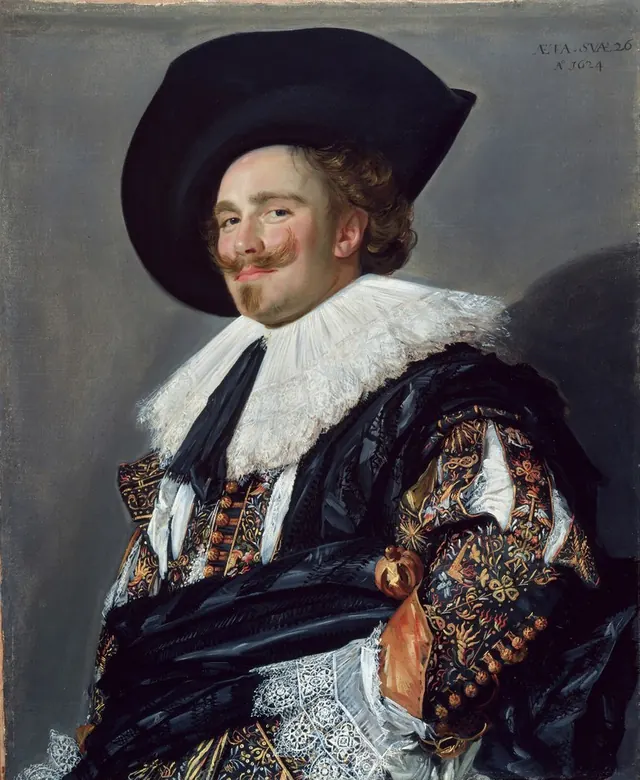
The painting’s story and details
In this 1624 portrait the man is not laughing aloud; the corners of his mouth merely rise slightly. Nor does the familiar word “cavalier” establish a military rank. The title took hold around 1888. The painting’s own inscription gives different information: his age, twenty-six. Frans Hals shows a young man wearing expensive French fashions available to the Dutch elite. Expressive immediacy coexists with a carefully considered presentation of standing.
The head turns away from the torso’s direction. Eyes look outwards, and the curling moustache reinforces the mouth’s movement. He seems to have just noticed us. Yet this impression is created by stable relationships of line, light and turn. The portrait holds a fleeting quality within a pose we can study for hours. Such convincing ease made Hals’s art especially effective in presenting a patron vividly.
The hat’s brim forms a large dark arc around the face. Its edge separates clearly from the grey background, although many close tones exist within the black. Hat, sash and outer clothing have different surfaces. Hals shows them through small changes in sheen and brush direction. A restrained palette can describe several expensive materials without reducing the figure to a single dark shape.
The white collar looks like intricate lace. Up close, light crossing strokes appear, with passages where the pattern is only suggested. Precision of effect does not require every loop to be drawn equally. The lace emphasises the face and displays the painter’s skill. The sitter presents expensive textile craftsmanship, while the artist translates it into another costly work made with a brush.
Numerous emblems and small figures are embroidered on the sleeve. The museum connects the ornament with love, strength, fortune and virtue. Such clothing displays qualities with which a person wishes to be associated. Youth, prosperity and a confident pose meet here. The love emblems support a possible role in courtship. In that reading the costume presents the young man as a desirable husband.
A broad black sash crosses the embroidered costume. Its large folds provide a pause after the fine ornament, while its diagonal supports the body’s turn. The elbow projects and the hand rests on the hip. The figure seems to occupy more space than the frame permits. Even while sitting for a painter, the patron is presented as someone at ease commanding the space around him.
The later title turns an unknown patron into the memorable type of a cheerful dandy. It helps us remember the picture but directs us towards laughter and adventure that the work does not narrate. Set it aside, and another combination becomes clearer: expensive clothing and the apparent ease of wearing it. The portrait presents privilege as something entirely natural and effortless.
Featured in tours
Portraits. How people presented themselves
Rulers, merchants, artists and private patrons before a viewer.
More paintings to compare


Period, style and subject
- Movement
- Baroque
- Genre
- Portrait
- Medium
- Oil on canvas
- Collection
- Wallace Collection, London
- Dimensions
- 83 × 67.3 cm
- Accession number
- P84
Sources
Reproduction of a public-domain artwork. Image licence