The Fortune-Teller
Georges de La Tour · probably 1630s
Explore the painting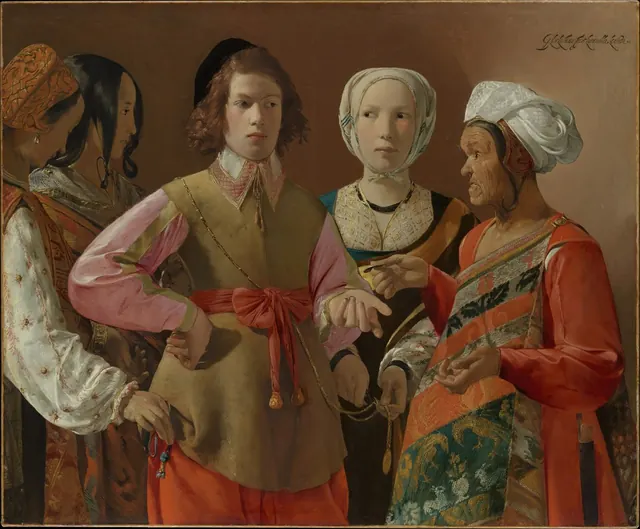
The painting’s story and details
An older fortune-teller accepts a coin from a richly dressed youth while three other women rob him. La Tour probably painted the scene in the 1630s, when such stories already circulated through prints and paintings. They let viewers recognise a trap before its victim. Here the deception fills a close group whose hands and eyes act almost independently of still bodies.
The youth holds his right hand at his hip, elbow thrust out. Pink sleeves, an embroidered collar and a chain display expensive dress. That assured pose becomes vulnerable in the crowd, with other hands already reaching his clothes from both sides. His fine appearance makes the impending loss tangible, since jewellery and purse belong to the visible display of means.
The fortune-teller on the right brings the coin towards the youth’s open palm. Her face turns towards him and her mouth is slightly open. She keeps attention on the fortune-telling. White fabric around her head and a red sleeve distinguish her, while their close hands create a clear centre of action as danger develops below and to either side.
At the waist, the woman on the right holds the hanging chain and brings small scissors towards it. The ornament is still attached to the clothing, so the theft is shown in progress. La Tour places slender fingers and metal against broad dark areas. The decisive action occupies little space and emerges after the bright faces and costumes.
On the left, the outermost woman draws a purse from the youth’s clothes. Behind her sleeve another hand waits to receive it. The encounter now resolves into a coordinated operation. Viewers can connect the separated actions while the youth’s head remains turned elsewhere. Knowledge of the event is distributed unevenly among its participants.
The young woman in a pale scarf looks sideways with scarcely a turn of her head. Her pale face and fine embroidery are as carefully finished as the victim’s clothes. Attractive appearance offers no reliable clue to her role. The story must be assembled from eye direction, fingers and objects passing between hands.
The patterned orange headdress on the left and the fortune-teller’s varied clothing gave the group an emphatically foreign appearance. The subject drew on European suspicion of Roma people and associated fortune-telling with deceit. It is a period artistic stereotype, made persuasive by the same skill that makes the fabrics and gestures so compelling to examine.
The signature at the upper right names Lunéville in Lorraine, where La Tour worked. The painting became known to scholars only in the mid-twentieth century and helped recover a wider range of his subjects. It is both a skilful account of inattention and evidence of art reinforcing prejudice. How readily do we trust a well-staged scene when it confirms a familiar suspicion?
More paintings to compare

Period, style and subject
- Movement
- Baroque
- Genre
- Everyday life
- Medium
- Oil on canvas
- Collection
- The Metropolitan Museum of Art
- Dimensions
- 101.9 × 123.5 cm
- Accession number
- 60.30
Sources
Image provided under CC0. Image licence