Woman Holding a Balance
Johannes Vermeer · c. 1664
Explore the painting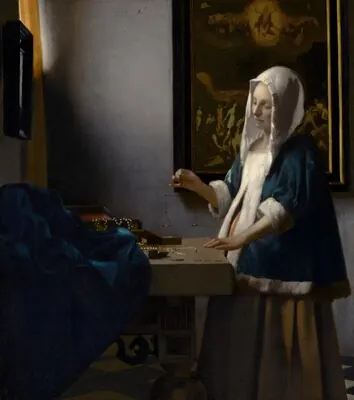
The painting’s story and details
In a room with a partly covered window, a woman holds a small balance. Jewellery lies before her, and a Last Judgment hangs behind her. Vermeer painted the scene around 1664. An everyday domestic activity sits beside an image of humanity’s final judgment. Their proximity has produced different interpretations, beginning with a simple question about what the balance contains.
Soft light touches her face and white cap. Her gaze falls towards the balance, and her body is almost still. Vermeer does not show a completed action; she seems to wait for the pans to settle. That pause gives us time to notice her relation to the picture behind her. Her head lies on the central axis of the Last Judgment, directly beneath Christ at its top.
The pans are empty. Microscopic examination showed that their pale spots differ from the pearls painted on the table. They are reflections of light. The work was formerly described as a woman weighing gold or pearls. When a familiar title no longer matches what is visible, the explanation changes too. Attention can shift to the moment of equilibrium itself rather than the valuation of jewellery by weight.
In the Last Judgment, Christ raises both arms above human figures below. The painting within the painting invites comparison between domestic weighing and the final assessment of a life. Historian Arthur Wheelock reads the scene as an image of moderation and self-examination. This interpretation rests on the objects and their arrangement, rather than a recorded explanation by Vermeer himself.
Pearl strands and a gold chain lie beside open boxes. Historian Herbert Rudolph connected them with the vanity of earthly wealth and read the woman as its personification. Wheelock challenges an unequivocal condemnation of her. The jewellery alone cannot settle the argument: pearls could signify both pride and purity in Christian culture. Meaning depends on the whole scene, rather than a fixed dictionary of symbols.
Her left hand rests on the table while her right holds the delicate instrument. The perspective converges near the hand with the balance. The pale wall and dark frame also direct attention there. Vermeer carefully anchors this small gesture in the room. Even a viewer who sets aside religious interpretation can see how much visual emphasis an almost imperceptible domestic action receives.
An Amsterdam auction catalogue of 1696 described the painting as being in a box. Such a housing could protect its surface from light and dust. Wheelock also proposes a particular viewing ritual, in which the owner opened doors and deliberately spent time before the image. This reconstruction is unproven, but it suggests a different rhythm of encountering a painting. The scene of equilibrium may have been revealed only temporarily, set apart from its everyday surroundings.
More paintings to compare
Period, style and subject
- Movement
- Baroque
- Genre
- Everyday life
- Medium
- oil on canvas
- Collection
- National Gallery of Art, Washington
- Dimensions
- Painted surface, 39.7 × 35.5 cm
- Accession number
- 1942.9.97
Sources
Reproduction of a public-domain artwork. Image licence