Haystacks: Autumn
Jean-François Millet · ca. 1874
Explore the painting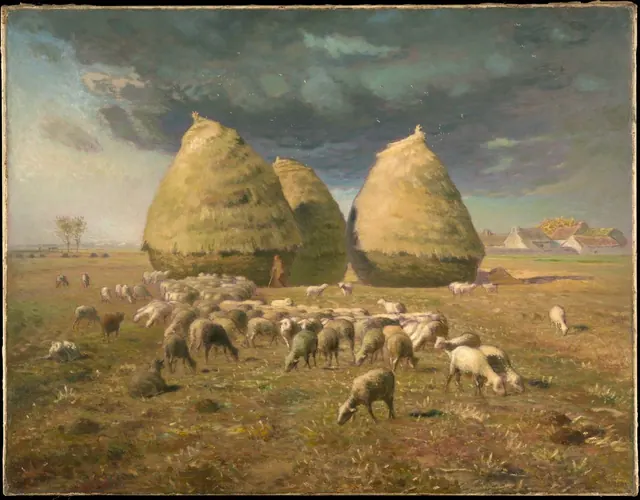
The painting’s story and details
Three enormous stacks rise above the sheep and shepherd. The harvest has been gathered, the gleaners have departed, and a flock has been let into the field. This is Autumn from a cycle commissioned by industrialist Frédéric Hartmann in 1868. Millet returned to it over several years, almost until his death.
The stacks appear taller than the distant houses. Their tips catch the light while their bases remain in shadow. Their bulk conveys how much has been gathered from the land. Millet makes the accumulated result of labor the landscape’s principal subject. Harvesting has ended, but its scale remains visible.
Sheep spread across the foreground, feeding on what remains after the harvest. Some lower their heads while others stand apart from the dense group. The rural year consists of successive tasks. After serving the harvesters, the field feeds animals while the gathered crop rests in stacks.
The shepherd stands near the base of the left stack and looks very small. In other Millet paintings, peasants occupy much of the canvas. Here a person is subordinated to the scale of field and harvest. His presence still measures the stacks and identifies the terrain as worked, productive land.
The roofs of Barbizon appear beyond the field. Millet settled there in 1849 and spent the rest of his life close to farming communities. While many rural residents moved to industrial towns, he traveled in the opposite direction from Paris. Harvesting, grazing, and work on the land became recurring subjects.
Lilac-pink passages of the underlying layer remain visible around the sheep and across the earth. Millet deliberately left them exposed. Preparatory drawing shows in places, especially around stacks and animals. This loose surface belongs to his late manner. The dark storm cloud above intensifies the yellow harvest’s brightness.
The cycle also included spring renewal, summer work, and winter, which Millet left unfinished. For the patron, the seasons became a sequence of paintings. For rural inhabitants, they determined working time, fodder, and reserves for the months ahead. The great stacks make dependence on this annual rhythm tangible.
More paintings to compare



Period, style and subject
- Movement
- Realism
- Genre
- Landscape
- Medium
- Oil on canvas
- Collection
- The Metropolitan Museum of Art
- Dimensions
- 85.1 × 110.2 cm
- Accession number
- 60.71.12
Sources
Image provided under CC0. Image licence