Moscow Courtyard
Vasily Polenov · 1878
Explore the painting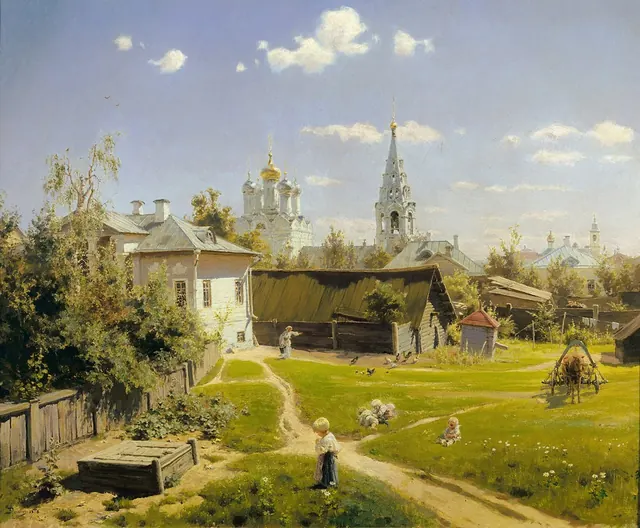
The painting’s story and details
In 1877 Vasily Polenov moved to Moscow and rented rooms near the Church of the Saviour on the Sands. The view from the house led to Moscow Courtyard, completed in 1878. Grass, sheds, a horse and children surrounded the church. Such yards belonged to the fabric of old Moscow, where urban estates included considerable open ground. Polenov made an ordinary neighbourhood of buildings and domestic activities a subject for landscape painting.
White church domes rise above trees and a service-building roof. The central dome’s gold stands out against blue sky. Seen from a courtyard, the church has a long shed in front of it. Buildings of different status share the same attention, each occupying its place in familiar surroundings. Historic architecture enters everyday life visible between a fence and a lawn.
The tall bell tower to the right of the domes cuts into a broad area of sky. Its pale silhouette has diminishing tiers, with dark openings making the structure legible from afar. Sloping roofs recur below. Alternating verticals and slopes establish the city view. An expansive sky lets us sense distances between buildings even where they partly overlap.
A harnessed horse stands at the right edge. A washing line stretches nearby, with small buildings beyond. Transport and domestic work occupied the ground directly beside residents’ homes. Today it might resemble a village, yet this is Moscow’s Arbat neighbourhood. The horse helps establish the scale of a historical city in which open land between houses remained a working space.
A girl in a pale blouse and dark skirt stands closest to us. Her head is inclined, with her hands before her body. Her small figure is fully visible where paths cross. She supplies a measure for the courtyard: path width, fence height and distance to the shed become easier to judge. An ordinary child anchors the landscape without participating in a major event.
Farther back, two children sit together in the grass, with another small child to their right. Pale clothing separates them from the green, but the figures remain small. Open ground lies between them. Polenov distributes activities across the yard, keeping each episode within a shared day. We can pause at any group and move along a path, as though no single action governs the place.
A woman beside the shed holds a bucket and extends her other arm. Hens move over a light patch of ground before the building. A few distinct areas of colour describe her as part of everyday activity. An open gate and shelter stand nearby. The landscape retains signs of use: a place to store things, tend animals and pass between house and yard.
Pale paths branch through the grass. Their widths vary, their edges are uneven, and flowers remain between them. The ground records residents’ habitual routes. Shaded grass is cooler; sunlight turns it yellowish. Changes of light connect the space while preserving the difference between worn earth and plants. Traces of movement make the yard inhabited even where nobody is passing now.
The first version was narrower and almost unpeopled. For the finished painting, Polenov broadened the view, adjusted the architecture and added everyday episodes. Apparent natural coexistence resulted from compositional work. His selection matters too: Moscow appears as a place accommodating children, household work and a church. The painting preserves a particular courtyard while suggesting that a city can be valued through the ordinary days lived within it.
Featured in tours
For children. Everyday life before us
Homes, school, trains and games in twelve paintings. For ages 8–12 and adults.
Russian life. Estate, city and village
How nineteenth-century painters depicted work, wealth, education and changes in everyday life.
Russian landscape. From study to painting
Twelve works about observation, travel and artistic choices, from Savrasov and Shishkin to Levitan and Nesterov.
More paintings to compare


Period, style and subject
- Movement
- Realism
- Genre
- Landscape
- Medium
- Oil on canvas
- Collection
- State Tretyakov Gallery
- Dimensions
- 64.5 × 80.1 cm
- Accession number
- 2670
Sources
Public domain. Reproduction from Wikimedia Commons. Image licence