Madonna and Child with Angels
Hans Memling · after 1479
Explore the painting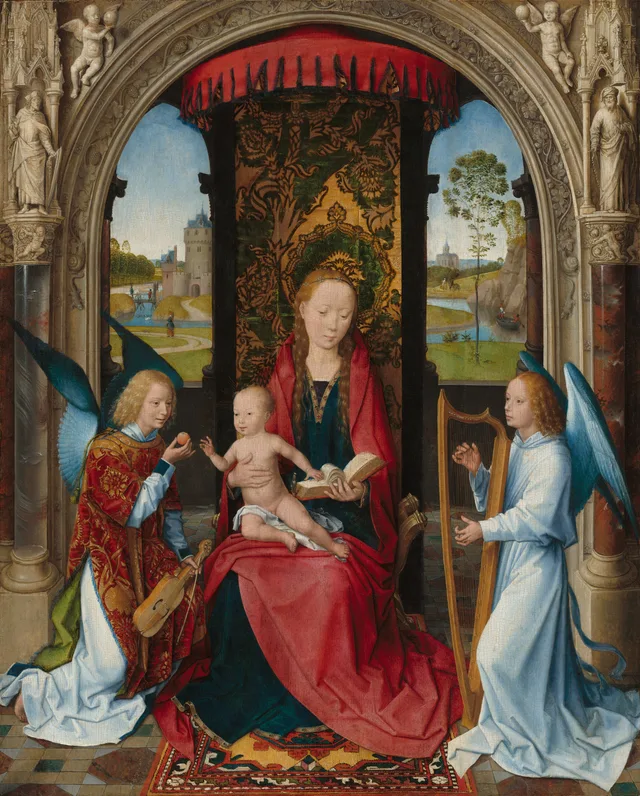
Mary sits enthroned beneath a rich canopy with two angels beside her. Memling worked in Bruges, a trading city where both local residents and foreign merchants commissioned devotional pictures. In this small painting, made after 1479, the heavenly gathering occupies surroundings familiar to a prosperous viewer. Textiles, a carpet, and carved architecture make the sacred scene tangible.
The child sits on Mary’s lap and reaches toward an angel, disturbing the throne’s formal stillness. His mother supports him while holding an open book. Reading and caring for a baby coexist without an abrupt division. Someone praying before the image could approach the Virgin through the familiar experience of family life.
The left angel offers the child a fruit while a stringed instrument hangs against his body. Gift and music come together in one figure. In Christian painting, fruit held by the Christ Child could recall the Fall and future salvation. Memling introduces that larger meaning through a small object received with a child’s familiar gesture.
The angel on the right holds a musical instrument. His pale garment balances Mary’s red dress and the patterned fabric opposite. The angels flank the throne like participants in a court ceremony. A familiar arrangement of honor is transferred to heavenly figures. Religious and secular culture share a visual language of respect.
A patterned cloth hangs behind Mary beneath the canopy, separating her from the landscape. Rich materials express her dignity while demonstrating the painter’s ability to distinguish surfaces. A viewer accustomed to judging the quality of cloth could appreciate both the devotional subject and the skill with which it was made.
The carpet reaches the picture’s front edge. Its pattern and the floor tiles lead toward the throne, while a stone arch encloses the gathering above. The space has depth and a legible entrance. Approaching the small panel allows its details to become part of an intimate, concentrated act of looking.
Landscape remains visible beside the canopy, keeping the sacred scene connected to the earthly world. This is a defining feature of the Northern Renaissance: belief takes visible form through carefully painted things. Today the carpet or instruments may attract attention first. For an early viewer, those same details helped sustain attention to the devotional image.
More works by Hans Memling
- Medium
- oil on panel
- Collection
- National Gallery of Art, Washington
- Dimensions
- 57.6 × 46.4 cm
- Accession number
- 1937.1.41
Sources
Museum reproduction. Public domain, NGA Open Access. Image licence