Portrait of a Man with an Arrow
Hans Memling · c. 1470/1475
Explore the painting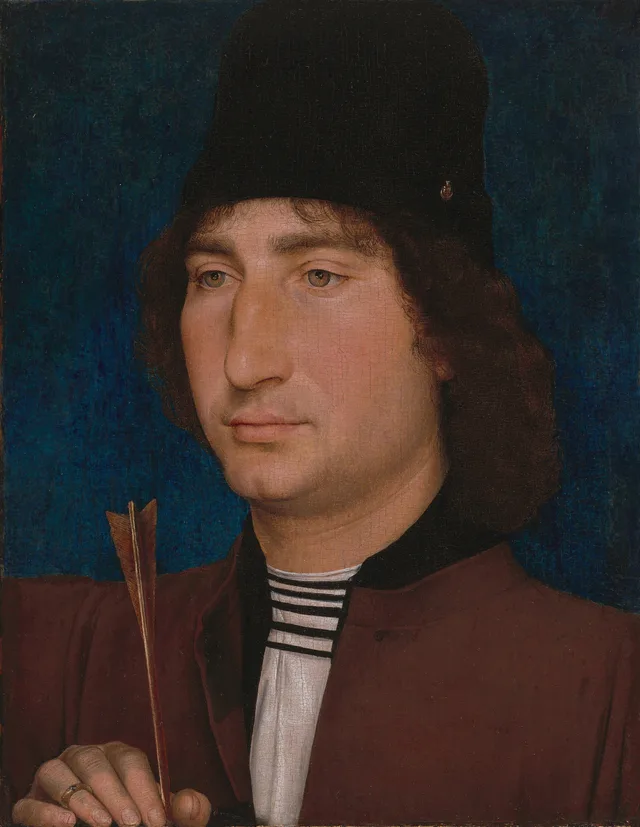
The man holds an arrow with its feathers clearly visible. Memling painted the portrait around 1470–1475, but technical study shows that the arrow was added after the initial composition. The addition is old and may be by Memling himself. The clue now defining the picture’s title therefore may not have belonged to its first conception.
The face is close, with little free space around the shoulders. Differences between the eyes, the nose’s curve, and shadow above the lip suggest a particular person. The skin never becomes a smooth mask. At the same time, the steady head and orderly clothing give the sitter a composed, dignified appearance. Individuality could coexist with a carefully chosen public image.
The arrow suggests several possible associations. Museum scholarship connects such an object with an archers’ guild, devotion to Saint Sebastian, or court tournaments. These belong to different areas of life: civic association, religion, and court service. None identifies the unknown man conclusively. The object nevertheless demonstrates how an attribute directs our reading of a face.
A tiny gold badge on the hat depicts the Virgin and Child on a crescent moon. Such an object could combine adornment with a declaration of religious devotion. Its scale rewards close viewing. Unlike the conspicuous arrow, the badge is easily missed, although its subject can be identified with considerably greater confidence.
The fingers rest against the lower boundary, placing the hand between the sitter’s space and ours. Conservation revealed a painted fly near his thumb. Such tiny illusions tested the viewer’s attention and demonstrated painting’s ability to seem alive. The insect occupies precisely the area where a painted surface might be mistaken for a real one.
A white shirt with dark stripes appears through the garment’s narrow opening. The arrow’s vertical line crosses these horizontal accents, integrating the small object into the portrait’s structure. Adding it changed both the sitter’s possible story and the movement of our attention from hand to face.
Memling worked in Bruges, where patrons came from commerce, civic life, and court circles. This man remains unnamed, but his image is far from empty. Badge, ring, gesture, and the later arrow preserve traces of how he was presented. The portrait offers a history of ways of describing a person as well as a likeness.
More works by Hans Memling
- Medium
- oil on panel
- Collection
- National Gallery of Art, Washington
- Dimensions
- 31.3 × 25.1 cm
- Accession number
- 1937.1.42
Sources
Museum reproduction. Public domain, NGA Open Access. Image licence