Circus Sideshow (Parade de cirque)
Georges Seurat · 1887–88
Explore the painting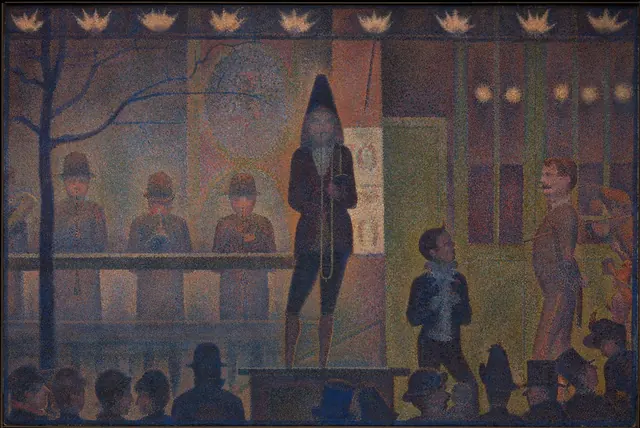
The painting’s story and details
In spring 1887 the Corvi Circus performed at the Gingerbread Fair near the place de la Nation in Paris. A free show outside the entrance encouraged passers-by to buy tickets. The French word parade means this promotional sideshow. Seurat chose a brief encounter between performers selling an attraction and people still deciding whether to go inside.
The trombonist stands on a separate platform. His instrument descends almost vertically and a pointed hat extends his narrow silhouette. His figure is visible from head to feet. Seurat leaves ample space on either side, allowing the musician to stand out even among the dark tones.
The other musicians line up behind the railing on the left. Heads and instruments appear at a similar level while their bodies remain partly hidden. A tree crosses the row and meets the canvas’s upper edge. Its long branch hangs above the band, bringing a living tree into the temporary stage’s straight-lined arrangement.
A small performer stands in profile to the trombonist’s right. Bent arms and an extended leg create a different pattern of movement from the musician’s upright figure. The platform rises above the audience, whose heads overlap the lower part of his costume. This overlap shows how closely the crowd approaches the stage.
The man at the far right appears in profile, with his hands near his waist. The scholar Richard Thomson proposed identifying him as the circus proprietor Ferdinand Corvi by comparison with later documents. This is an attribution rather than an established portrait. It recalls the owner, troupe and actual running costs behind a travelling show.
Along the bottom, spectators obstruct one another with hats and the backs of their heads. We look through the crowd and see only part of the event. Daumier used similar viewpoints for street performers. Nineteenth-century caricature could turn a barker into a politician promising wonders, though Seurat supplies no such explicit satirical key here.
Round lights on the right and flames along the upper row illuminate the platform in separate patches. Close up, the surface consists of numerous coloured dots. Orange and blue run through both figures and darkness. Gaslight posed a particular challenge for Seurat: how to render the colour of a nocturnal spectacle on canvas.
The line of lights repeats the horizontal railing. Between them the figures appear almost motionless, though the musicians must be playing and the barkers addressing the crowd. A noisy event acquires a strict, readily surveyed arrangement. This produces the painting’s strangeness: the show continues, but each movement seems held in place.
At the Salon des Indépendants in 1888 Seurat exhibited this work beside Models, an indoor daylight scene. He tested one painting technique under opposing conditions. Behind the free performance lies ticket selling; behind flickering light lies sustained work with colour. The painting brings the workings of urban entertainment together with a new pictorial experiment.
Featured in tours
After Impressionism. Four different answers
Seurat, Cézanne, Van Gogh and Gauguin changed painting for different reasons.
More paintings to compare
Period, style and subject
- Movement
- Neo-Impressionism
- Genre
- Everyday life
- Medium
- Oil on canvas
- Collection
- The Metropolitan Museum of Art
- Dimensions
- 99.7 × 149.9 cm
- Accession number
- 61.101.17
Sources
Image provided under CC0. Image licence