Seascape at Port-en-Bessin, Normandy
Georges Seurat · 1888
Explore the painting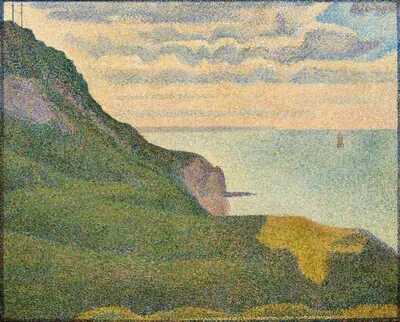
The painting’s story and details
In the summer of 1888 Seurat spent six weeks at Port-en-Bessin, a Normandy fishing port, and made six paintings. Here he turns from the harbour’s daily life towards cliffs and sea. Coastal visits regularly alternated with work in Paris. Open space gave him opportunities to investigate colour and landscape structure across large, clearly separated areas.
The green slope occupies almost the entire left side and descends diagonally towards the water. Yellow, blue and pinkish touches appear within the green. Small strokes follow the surface of the hillside and convey its incline. The area retains a broad, coherent shape even though, close up, it separates into numerous individual marks of colour.
The exposed cliff faces are painted in lilac, pink and blue. The rock appears much cooler than the grass above it. Seurat carefully distinguishes neighbouring surfaces by colour, while clear edges maintain their volume. Shadow also consists of differently coloured touches, its darkness emerging from their combination and density while remaining connected to the rest of the palette.
On the right the shore drops towards the sea, whose surface opens beyond the cliff. The land’s steep diagonal meets the sea’s nearly horizontal bands. These two directions organise the landscape. The fishing port lies nearby, but human activity occupies little space in this chosen stretch of coast. Slope, rock and broad water establish its scale.
From a distance the sky looks pale and even. Close up, blue, yellowish and pink dots become visible. Seurat extends the divided brushstroke across the entire surface, including its quietest areas. The colour impression depends both on viewing distance and on neighbouring hues. The dots nevertheless remain physical brush marks that can be examined individually.
A narrow border runs around the edge, also painted in coloured dots. It belongs to the painting itself. Its hues change beside the pale sky, sea and darker land, contrasting with them. Seurat’s colour work therefore continues to the canvas’s outer boundary: he includes the point where the image meets the surrounding wall in his composition.
In February 1889 the six Port-en-Bessin views were exhibited together. Three depicted the harbour and quays, and three the surrounding cliffs. Elsewhere in the series appeared a bridge and fish market, features of an active modern port. This quiet shore belonged to a broader study of a place where natural forms coexisted with commerce, buildings and maritime work.
Featured in tours
After Impressionism. Four different answers
Seurat, Cézanne, Van Gogh and Gauguin changed painting for different reasons.
More paintings to compare
Period, style and subject
- Movement
- Neo-Impressionism
- Genre
- Marine painting
- Medium
- oil on canvas
- Collection
- National Gallery of Art, Washington
- Dimensions
- Overall, 65.1 × 80.9 cm
- Accession number
- 1972.9.21
Sources
Reproduction of a public-domain artwork. Image licence