A Sunday on La Grande Jatte
Georges Seurat · 1884–1886; border 1888–1889
Explore the painting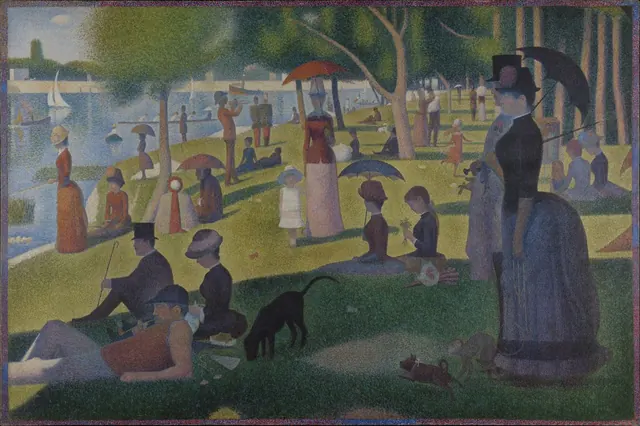
The painting’s story and details
On the bank of the Seine, people stroll, sit in the shade and watch the boats. Seurat devoted a canvas more than three metres wide to Sunday leisure. Yet this casual outing looks extraordinarily deliberate. Gaps separate the figures, outlines are sharply defined, and upright bodies echo the tree trunks. The artist worked on the scene for two years. When the twenty-six-year-old Seurat first showed it at the Impressionist exhibition in 1886, it proposed a new way of painting modern life.
On the left a man with a pipe reclines on the grass. Behind him sit a gentleman in a top hat with a cane, and a woman. Their clothing suggests different social habits, although we cannot establish each person’s occupation. Seurat spoke of giving modern people the ordered arrangement of figures on an ancient frieze, a long band of relief sculpture. Strict profiles and restrained poses arrange the visitors in such a sequence. People whose means and daily lives may have differed considerably share the same ground.
Rowing boats and sailing boats appear on the water, while a musician with a brass instrument stands near the bank. La Grande Jatte was a place of recreation outside Paris. Museum research records restaurants, dancing establishments and boatyards on the island, with factories nearby. Seurat selects a green stretch of bank. The city provides this public with work and entertainment, but its production largely disappears from view. His choice determines the version of the place we remember.
The girl in white faces the viewer, beside a woman under a parasol. The child’s pale dress stands out among darker silhouettes and helps establish the centre of the composition. Seurat prepared figures separately in drawings and small oil studies. He changed their outlines and arrangement on the final canvas. Each figure’s exact position is therefore the outcome of a long process of selection. Here, many separate observations have been brought together into a single Sunday.
The couple on the right have particularly rigid profiles. The man’s top hat and the woman’s parasol rise above the others, while her bustle projects sharply behind her. The museum’s interpretation allows an ironic reading of their fashionable appearance: a walk becomes an occasion for self-display. We might see an orderly society in which everyone has a place, or sense the distance between people standing together. The composition supports both impressions. Order on the canvas does not in itself establish harmony in the society represented.
The monkey at the woman’s feet is on a leash. A small dog is nearby, while a black dog further away lowers its head to the grass. The animals introduce movement along the bottom of the picture, where the large human figures appear almost motionless. Seurat added the monkey late in the painting process. It is now so conspicuous that the scene is difficult to imagine without it. Such changes reveal the decisions behind an apparently settled arrangement. The artist continued to adjust it after the principal figures were already in place.
Enlarged, the greenery separates into small coloured marks. This is pointillism, painting with individual dots. Seurat studied colour theory, including the chemist Michel Eugène Chevreul’s work on how neighbouring colours affect one another. He expected separately applied colours to create a more vivid visual impression. At a distance the eye brings them together; close up we can follow individual touches of the brush. The dots cover earlier painting begun with broader strokes. The picture’s method developed along with its cast.
Coloured dots continue into the border around the canvas. Seurat added it in 1888–89, after the first exhibition. Its colours change alongside different areas of the image, making the picture’s boundary part of its colour arrangement. The border is painted on the same canvas and belongs to the image itself. Enlarging the edge reveals how his work with colour continues beyond the grass, trees and sky.
After Seurat’s death the painting passed to his family. It was bought for 800 francs in 1900; in 1924 Chicago collectors Frederic Clay and Helen Birch Bartlett acquired it for 20,000 dollars. These sums cannot be compared directly, but the sales history traces the work’s changing position in the market. It entered the museum in 1926. A painting of Parisian leisure became available to a different public in Chicago. Digitisation now lets us examine its dots much more closely than an ordinary visitor in the gallery.
Featured in tours
After Impressionism. Four different answers
Seurat, Cézanne, Van Gogh and Gauguin changed painting for different reasons.
World classics. Altar, palace, exhibition
Familiar paintings and the people for whom they were made.
More paintings to compare
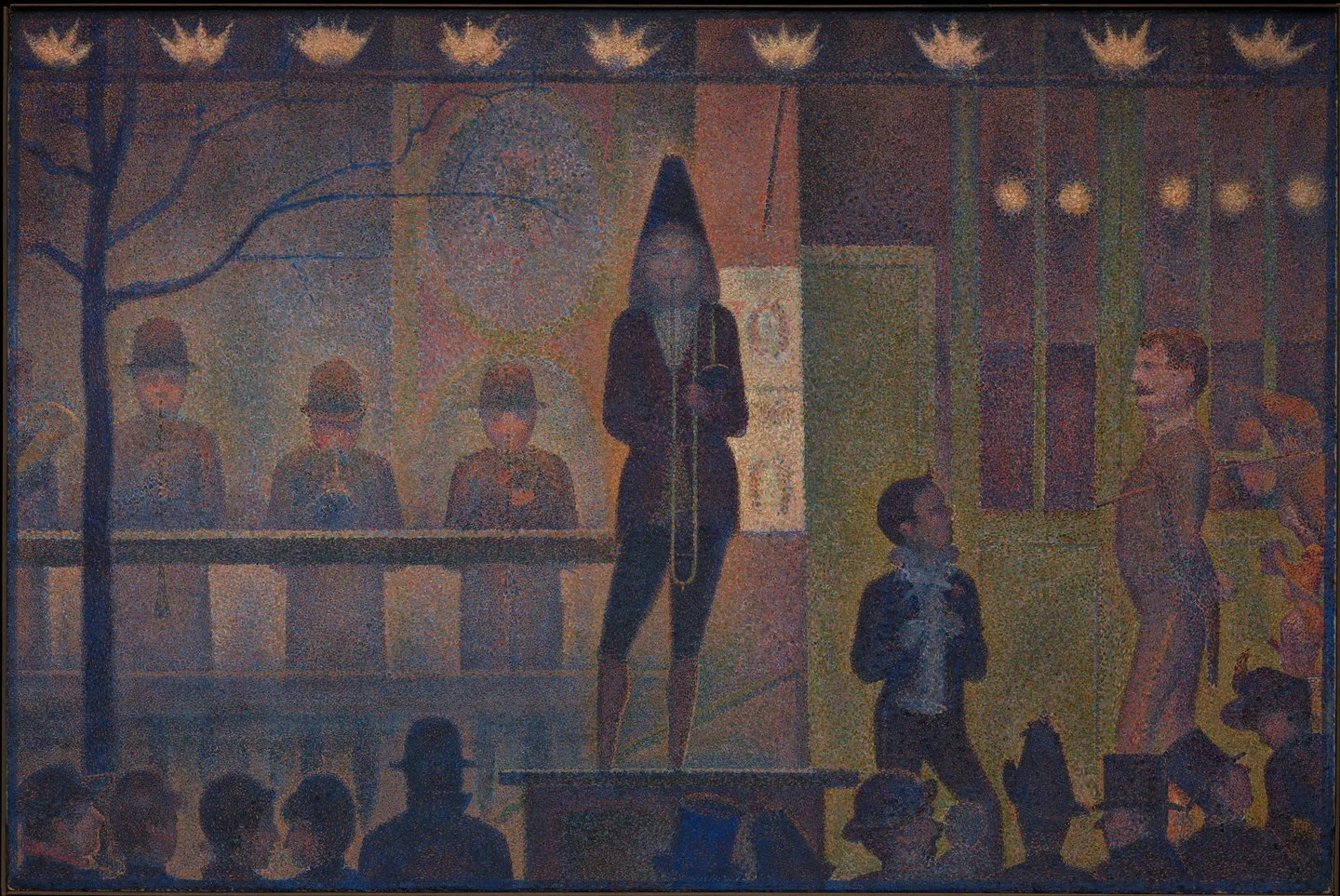 Georges Seurat
Circus Sideshow (Parade de cirque)
1887–88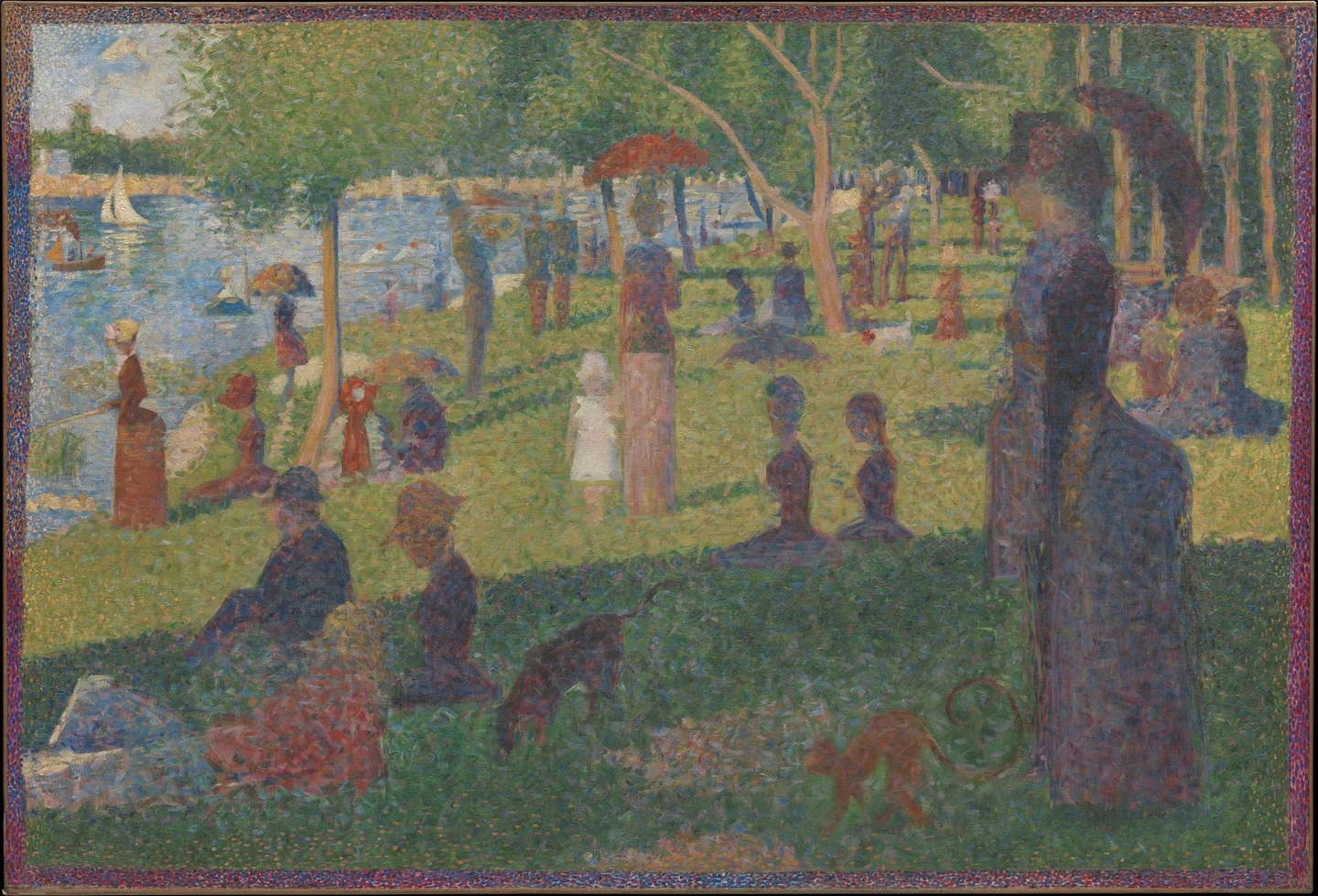 Georges Seurat
Study for "A Sunday on La Grande Jatte"
1884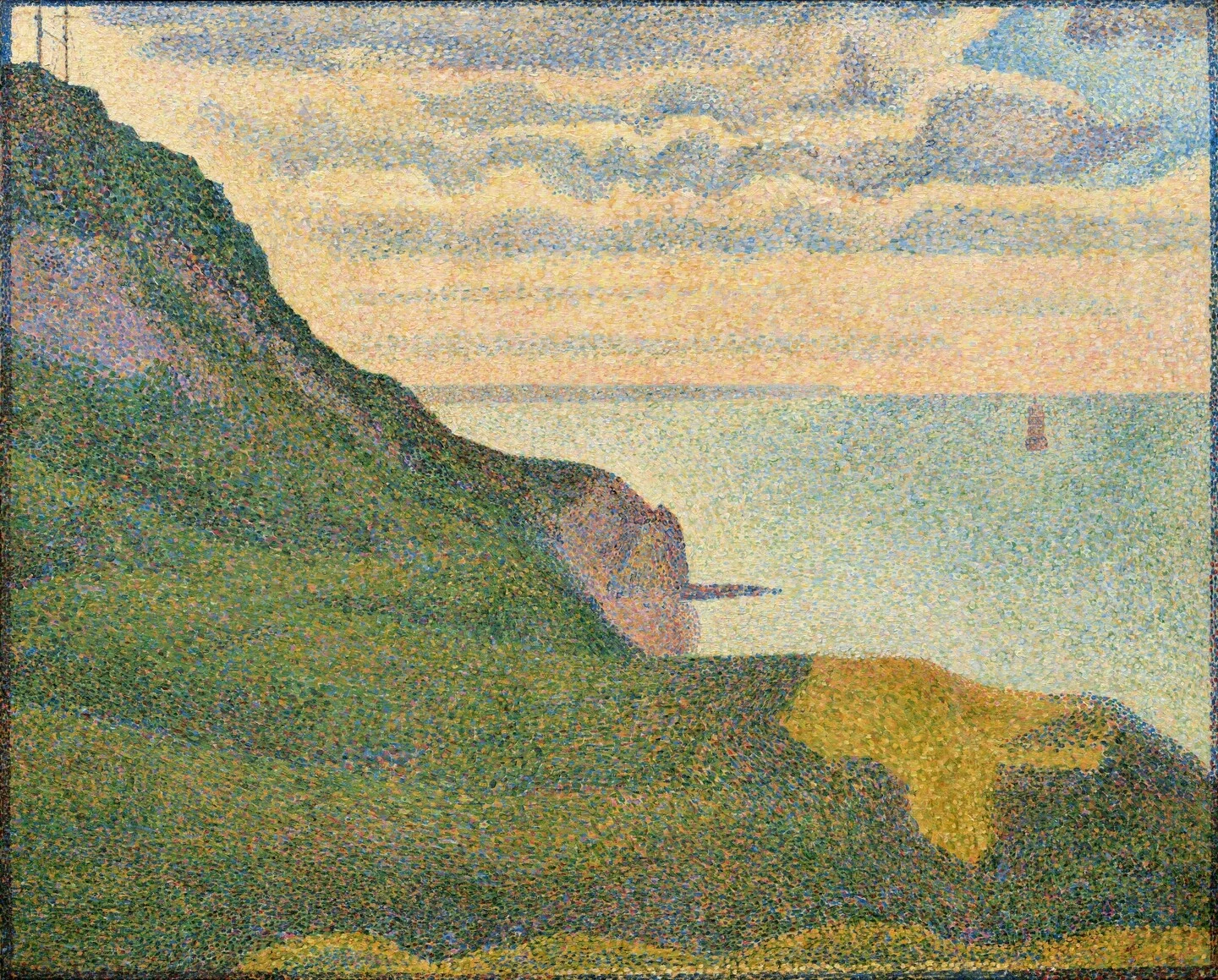 Georges Seurat
Seascape at Port-en-Bessin, Normandy
1888 Vincent van Gogh
The Bedroom. Second version
September 1889 Henri de Toulouse-Lautrec
At the Moulin Rouge
1892–95 Henri de Toulouse-Lautrec
Equestrienne (At the Cirque Fernando)
1887–88Period, style and subject
- Movement
- Post-Impressionism
- Genre
- Everyday life
- Medium
- Oil on canvas
- Collection
- Art Institute of Chicago
- Accession number
- 1926.224
Sources
Public-domain faithful reproduction under Wikimedia Commons PD-Art assessment. Image licence