Study for "A Sunday on La Grande Jatte"
Georges Seurat · 1884
Explore the painting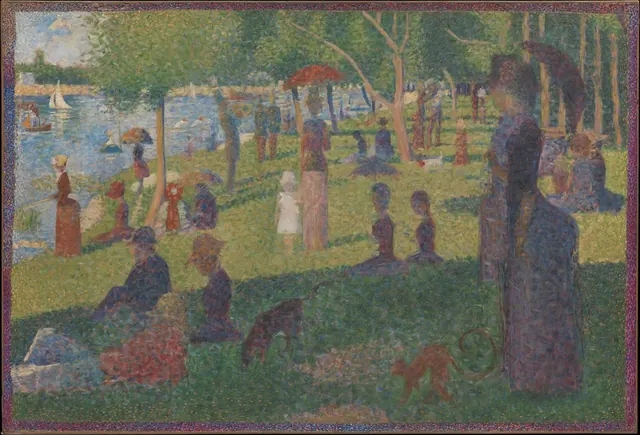
The painting’s story and details
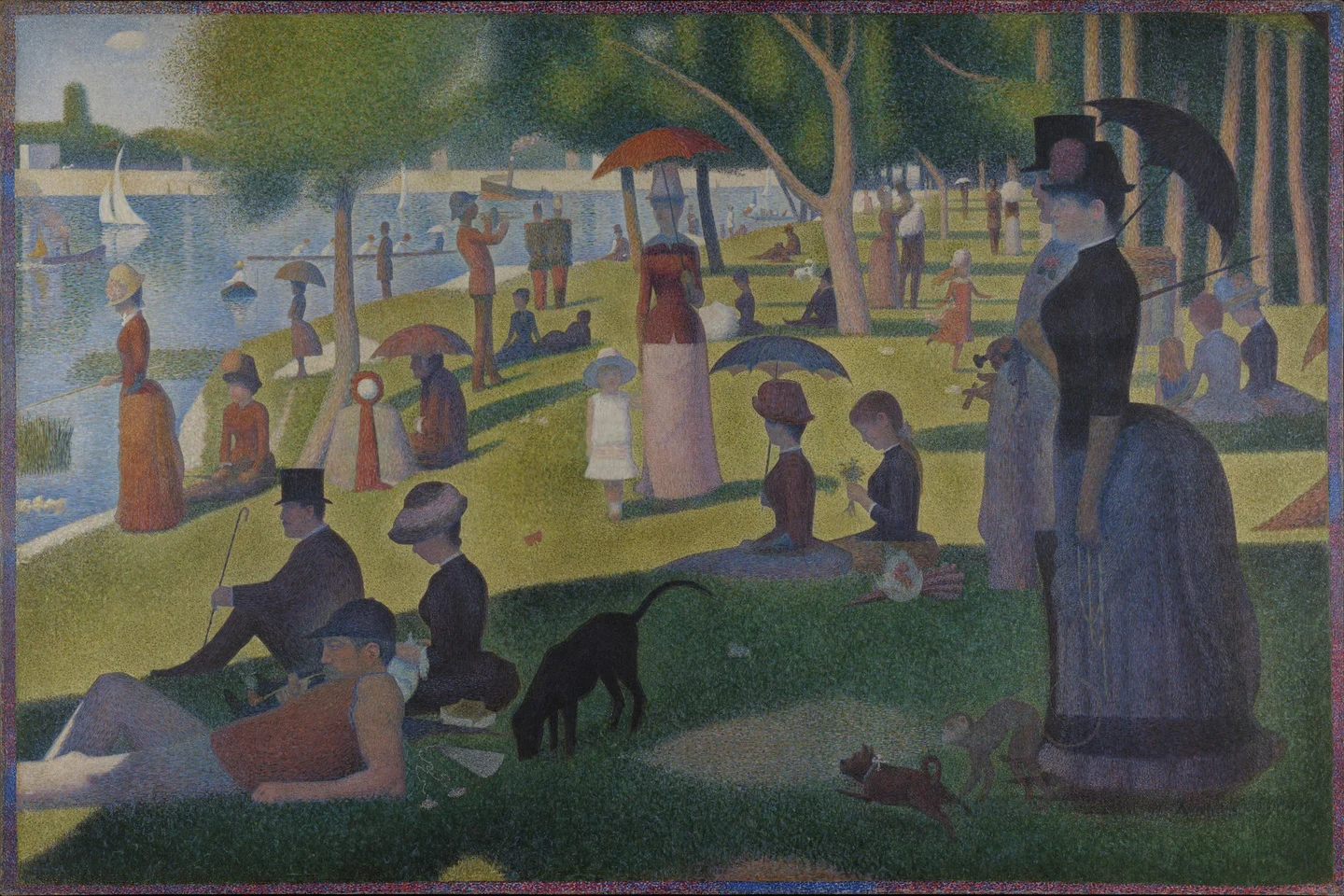
Sunday leisure on an island in the Seine occupied Seurat for two years. He made drawings and small studies, rearranged figures and changed how he applied colour. This is the final large preparatory study, painted in 1884. He presented the finished canvas, now in Chicago, in 1886. A familiar Impressionist subject became the basis of a carefully calculated image of the urban public.
A woman with a dark parasol fills almost the entire height of the right foreground. Her profile and projecting skirt create a distinct silhouette. Her costume retains its shape among the varied brushstrokes. Beside the small figures farther away, she seems particularly still. This change of scale accommodates many people within a relatively narrow strip of riverbank.
Another woman stands beneath a red parasol in the centre, beside a child dressed in light colours. This group provides a second clear landmark. The child’s clothing stands out against the grass, while the parasol echoes warmer touches elsewhere. Seurat connects separate figures through colour, even when they do not engage with one another. A shared order emerges across the painted surface.
On the shaded bank to the left, people sit or recline. Their low, extended silhouettes differ from the standing figures farther back. By the 1880s, the island had become a popular destination for Parisians’ Sunday outings. The park let city dwellers remain among a crowd while choosing individual activities, whether looking at the water, talking or resting on the grass.
A dog lowers its head towards the ground near the bottom. Its back and slender legs interrupt the succession of still human silhouettes. A small monkey with a curling tail appears nearby. The picture offers different scales of attention: large figures register immediately, while animals and minor gestures emerge gradually. This densely populated foreground was already developed in the study.
Boats and sails occupy the stretch of river opening out on the left. Bands of blue water separate them. The Grande Jatte belonged to a contemporary Parisian culture of leisure on the Seine that the Impressionists had already painted. Seurat took a familiar location and populated it with figures whose sizes, intervals and directions can be compared almost like elements of a regular pattern.
Tree trunks divide the space into vertical sections. Around them, green, yellow and blue strokes remain distinct. Seurat called his principle of separating colour Divisionism. Adjacent touches were intended to combine in the viewer’s perception. In this study the marks are still elongated and criss-crossed; on the large canvas, he made them smaller and closer to dots.
The coloured border was added to the study later, in 1888–89. This preparatory work therefore continued to occupy Seurat after the famous painting was finished. It preserves several stages of his research. A Sunday outing often suggests a fleeting impression, yet this image reveals sustained work on how the eye assembles colour and how many separate figures become a whole.
Featured in tours
After Impressionism. Four different answers
Seurat, Cézanne, Van Gogh and Gauguin changed painting for different reasons.
More paintings to compare
Period, style and subject
- Movement
- Neo-Impressionism
- Genre
- Everyday life
- Medium
- Oil on canvas
- Collection
- The Metropolitan Museum of Art
- Dimensions
- 70.5 × 104.1 cm
- Accession number
- 51.112.6
Sources
Image provided under CC0. Image licence