Saint Andrew
Simone Martini · ca. 1326
Explore the painting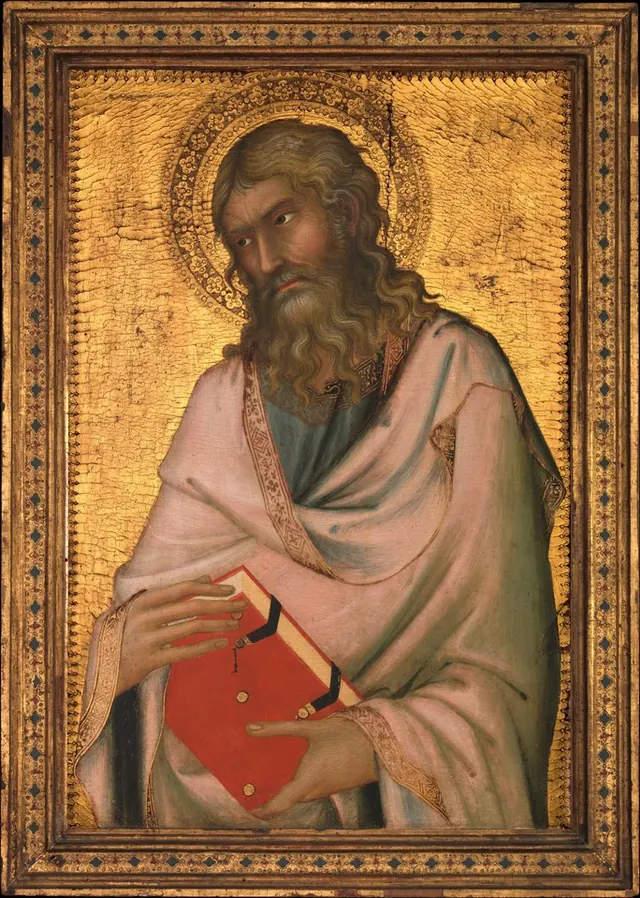
The painting’s story and details
Saint Andrew looks left, beyond his own panel. In the original altarpiece, the Virgin and Child occupied that direction. Simone Martini painted the five-part ensemble around 1326. Each figure was connected to its neighbours through the direction of its gaze and the shared gold background. The altarpiece may have been commissioned by Siena’s civic government. Saints could belong within the setting of public authority as well as a church, helping to express an idea of its obligations. Each figure’s position contributed to the reading of the whole.
Andrew tilts his head slightly. His eyebrows draw together, his eyes turn sideways, and the long strands of his beard differ in colour. The face has enough particular features to feel human and individual. It is an imagined likeness of an apostle who lived many centuries before Simone. Age, physical presence and a concentrated gaze make a distant figure from sacred history recognisable. For someone praying, the image offers a person to address.
The book is held through two different movements. One hand rests on its cover and the other supports its lower edge. The pale page block establishes its thickness; black straps and metal fittings suggest its construction. Simone follows the curves of the fingers closely. The book associates the apostle with the transmission of Christian teaching, while the gesture gives that meaning everyday physical credibility. A precious object has weight and needs a secure grip.
The pink fabric gathers in broad folds across the chest. Dark areas recede and lighter ones project. The patterned border turns with the garment’s edge, making its movement easy to follow. Flowing lines work together with a sense of volume. This combination reveals a strength of Sienese painting. We can become absorbed in the ornament while understanding how the cloak curves around the shoulder and arms beneath it.
Rows of small impressions surround the head in the gold. The halo distinguishes the apostle even though its colour scarcely differs from the background. The image is made through both brushwork and the working of a surface. Painted shadows shape the face; actual light also affects the depressions in the gold. As the viewer moves, the metallic surface reflects light differently. A photograph therefore preserves only one appearance of an object seen under changing illumination. Clearly visible at close range, the pattern becomes part of the overall radiance around the head when seen from farther away.
The rectangular frame survives from the original work, but it was later detached and replaced upside down. Researchers identified a precise trace of that alteration. The halo, cropped at the top of the panel, continues on an inner moulding now at the bottom. Even the surround records the painting’s physical history. The suggestion that the entire altarpiece folded for transport rests on its unusual construction; the frame catalogue treats the evidence of former fittings cautiously.
In another panel, Saint Ansanus held Siena’s black-and-white banner. That specific civic identity supplemented the altarpiece’s devotional meaning. If the commission came from the government, veneration of heavenly patrons helped present the city as a shared undertaking for which its rulers were responsible. The panels are now in different museums. Andrew can easily appear to be an independent portrait, although his gaze still recalls the missing centre and the former assembly of saints.
Featured in tours
Florence and Rome. Patrons of the Renaissance
Merchants, monasteries, the Medici and the papal court. The changing work of artists from the thirteenth to the sixteenth century.
Christian images. From mosaic to Caravaggio
Icons, manuscripts, domestic devotional pictures and church altarpieces.
More paintings to compare
Period, style and subject
- Movement
- Proto-Renaissance
- Genre
- Religious art
- Medium
- Tempera on wood, gold ground
- Collection
- The Metropolitan Museum of Art
- Dimensions
- 57.2 × 37.8 cm
- Accession number
- 41.100.23
Sources
Image provided under CC0. One surviving panel of a five-part altarpiece. Image licence