Lamentation
Giotto di Bondone · 1303–1305
Explore the painting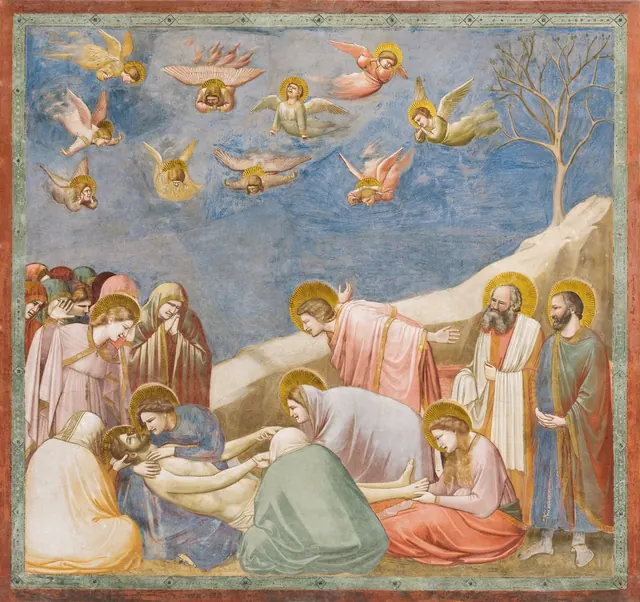
The painting’s story and details
Christ has been taken down from the cross. Mary bends towards his face, women support his body, and disciples stand nearby. Giotto painted the scene in 1303–05 on a wall of the Scrovegni Chapel in Padua. It belongs to an extensive account of Mary’s and Christ’s lives. A chapel visitor has already encountered betrayal and crucifixion and will go on to the Resurrection. Here the narrative pauses over death and those left to mourn.
Enrico Scrovegni commissioned the chapel beside his palace. His family’s wealth came from finance. A familiar account explains the commission as atonement for his father’s usury. The museum’s current history qualifies that account. Enrico was concerned with his own salvation and his family’s standing among Padua’s leading houses. A religious gift also became a conspicuous urban undertaking, preserving its patron’s name alongside the painter’s work.
Mary looks into her son’s face from the distance at which one would normally address someone alive. His head, however, falls back; his eyes are closed and his arms lie still. The difference between her inclination and his immobility makes death apparent without an inscription. Giotto concentrates the action near the left edge. Hands, turning heads and even the rocky ridge converge on this crowded place.
John leans sharply forward, sweeping his arms back. His gesture occupies far more space than the seated women’s movements. Broad pink clothing suggests the body beneath the fabric. He reaches towards Christ with his whole posture without touching him. Among the mourners, Giotto distinguishes those supporting the body, those standing nearby, and a man whose grief takes the form of abrupt movement.
Two women sit with their backs towards us. Their faces are largely hidden, but rounded shoulders and broad folds occupy the foreground. They conceal part of Christ as people would obstruct one another in a close gathering. Giotto treats the body as a whole, with weight and a position among other bodies. Even a figure whose face is hidden contributes to the story through posture and touch.
Mary Magdalene supports Christ’s feet. Long hair falls towards her hands, and pink clothing distinguishes her figure on the right. Her position at his feet extends the group across the fresco’s lower part. Christ’s body connects the mourners’ separate actions. No one is occupied with an unrelated task, although their ways of participating differ.
In the sky angels throw back their heads, cover their faces and twist in flight. Their small bodies repeat the varied human responses below. Open blue ground separates the figures so that each gesture remains legible. Mourning extends throughout the image. Within the Christian narrative, one body’s death becomes an event involving the heavenly world too.
From the tree on the right, the rocky ridge descends towards Mary and Christ. This long diagonal connects the largely empty upper area to the crowded figures below. Landscape organizes the movement of the eye. Starting at the tree, the line leads towards the faces; starting at the faces, it opens space above them. The dramatic focus persists even when attention wanders.
Later painters, including Masaccio and Michelangelo, studied Giotto’s work. His substantial figures, spatial overlaps and legible gestures offered new ways to tell human stories. These explorations developed within religious commissions in the early fourteenth century. Scrovegni sought salvation and honour for his family; Giotto made an image of loss that many different viewers could approach. In the chapel’s history, a patron’s personal interests became closely connected with art’s significance for others.
Featured in tours
Florence and Rome. Patrons of the Renaissance
Merchants, monasteries, the Medici and the papal court. The changing work of artists from the thirteenth to the sixteenth century.
Christian images. From mosaic to Caravaggio
Icons, manuscripts, domestic devotional pictures and church altarpieces.
World classics. Altar, palace, exhibition
Familiar paintings and the people for whom they were made.
More paintings to compare
Period, style and subject
- Movement
- Proto-Renaissance
- Genre
- Religious art
- Medium
- Fresco
- Collection
- Scrovegni Chapel, Padua
Sources
CC BY-SA 4.0. Resized previews and tiles prepared for display; no retouching or upscaling. Image licence