Madonna and Child
Duccio di Buoninsegna · ca. 1290–1300
Explore the painting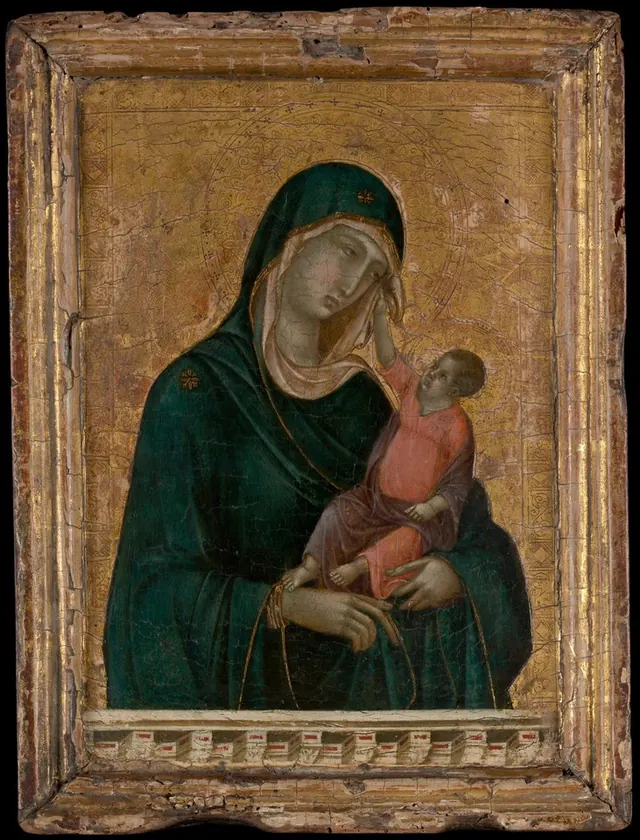
The painting’s story and details
This Madonna is small enough to hold. Duccio painted it around 1290–1300 for private devotion. Candle burns survive along the lower edge. They offer evidence of how the painting was used long before it stood behind museum glass. Its original owner is unknown.
The infant reaches for his mother’s veil, catching the fabric beside her cheek. It is a gesture familiar from everyday life with a small child. Duccio retains the gold ground and halos of a sacred image while giving mother and son a tangible physical closeness.
Mary looks down, her mouth closed. In a Christian reading, her sadness anticipates Christ’s future suffering. The infant’s affectionate gesture accompanies a reminder of how his earthly life will end.
The greenish face reflects the painting’s condition. Flesh tones were applied over a green preparatory layer. Some of the upper paint has been lost, exposing more of this underpainting. The skin now looks different from what the first owner saw.
A narrow parapet appears below the child’s feet. It has a top, a front face and small projecting supports beneath. This painted ledge establishes space in front of the figures. The gold background, meanwhile, becomes neither a room nor a landscape.
Gold edging follows the folds of Mary’s dark cloak. Around the heads, the gold is worked differently, with patterns in the halos. Light is conveyed through colour, line and actual reflection from metal. Candlelight would have made those differences especially apparent.
Duccio worked in Siena, receiving commissions from both religious and civic institutions. He later painted the enormous Maestà for its cathedral. A small domestic Madonna and a great cathedral altarpiece belonged to the same religious culture, within which painters developed new ways to represent bodies and human relationships.
Featured in tours
Florence and Rome. Patrons of the Renaissance
Merchants, monasteries, the Medici and the papal court. The changing work of artists from the thirteenth to the sixteenth century.
Christian images. From mosaic to Caravaggio
Icons, manuscripts, domestic devotional pictures and church altarpieces.
More paintings to compare
Period, style and subject
- Movement
- Proto-Renaissance
- Genre
- Religious art
- Medium
- Tempera and gold on wood
- Collection
- The Metropolitan Museum of Art
- Dimensions
- 27.9 × 21 cm
- Accession number
- 2004.442
Sources
Image provided under CC0. Image licence