Wangchuan Villa
Wang Yuanqi · dated 1711
Explore the painting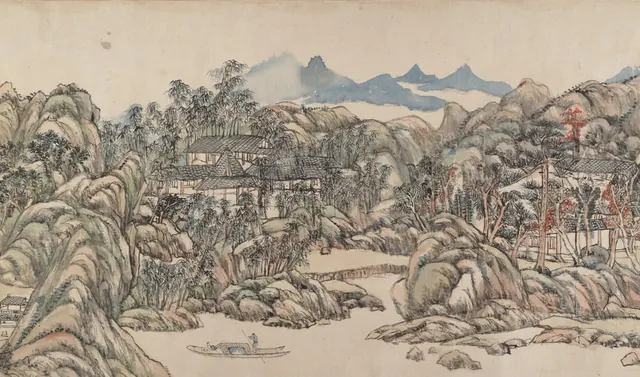
The painting’s story and details
In 1711, Wang Yuanqi painted Wangchuan, the country retreat of the poet Wang Wei, who had lived almost a thousand years earlier. A long history of images stood between the painter and the place. He worked from a rubbing of a stone engraving made in 1617 and from the poet’s verses. The resulting landscape combines the memory of a famous garden with the artistic concerns of a later age.
Open buildings with tiled roofs stand among trees. Vegetation almost conceals the walls, while the straight architecture contrasts with rounded rocks. Wang Wei was both poet and painter, and his estate became a celebrated image of scholarly retreat. Here the buildings occupy a small area within mountains, water and groves. Architecture provides a place for people within an extensive natural setting.
A bridge crosses the water between rocky banks. Its narrow horizontal line connects areas separated by mountains and a channel. Another pale strip of water appears behind it. Such passages open up the landscape, with a dense group of rocks giving way to empty space. Each building and shore belongs to a larger setting, so even this detail suggests terrain extending beyond the reproduction’s edges.
At the bottom, a person stands in a long boat with a covered compartment. The small figure gives scale to nearby trees and buildings. Little paint covers the surrounding water, making the fine lines of the hull clear against the pale paper. It separates the banks and permits movement within a densely packed mountain landscape.
On the right, pines and red-leaved trees surround a pavilion. Thin straight lines describe its roof and fence, while needles gather into dark fans. These differences distinguish architecture through the branches. The garden accommodates human presence, with shelter, water and connecting passages.
Rounded mountain folds recur around the buildings. Dark strokes follow their curves, marking ridges and hollows. Wang Yuanqi described connections between mountain masses as “dragon veins” and associated them with the movement of vital breath. These terms belong to his artistic theory. On paper, the connections emerge through visible means: recurring outlines, concentrations of ink and intervals between rocks.
Distant peaks appear as blue patches. They have fewer details than the nearer slopes, and a pale interval separates them from the buildings. This is a section of a long scroll that would be unrolled in stages. No single viewpoint encompasses the whole estate at once. Foreground banks, tall mountains and roofs seen from above gradually form an extended space.
Wang Yuanqi advised the Kangxi emperor on the imperial painting collection. Supporting traditional culture helped the Manchu Qing dynasty cultivate China’s educated elite. Returning to an ancient poet therefore mattered beyond private enjoyment of a garden. The court valued the same artistic continuity this painter demonstrated.
Featured in tours
Chinese landscape. The scholar’s life
Public service, retirement, gardens, poetry and the memory of earlier masters.
More paintings to compare
 Mi Youren
Cloudy Mountains
1130 Wen Zhengming
Autumn Mountains 秋山圖
Ming dynasty (1368–1644), early 16th century 明朝 Wang Meng
Quiet Life in a Wooded Glen 林麓幽居圖
Yuan dynasty (1279–1368), dated 1361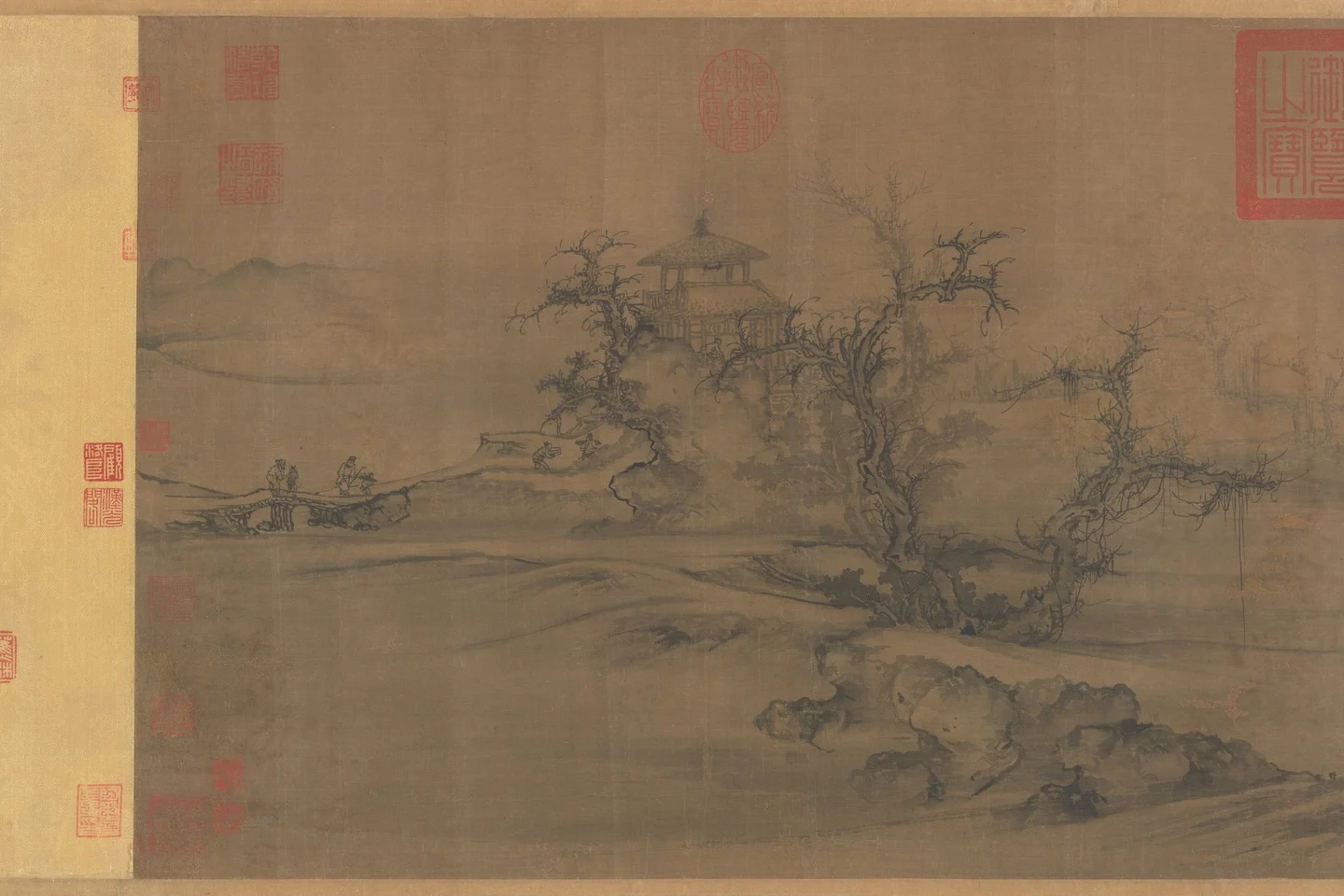 Guo Xi
Old Trees, Level Distance
ca. 1080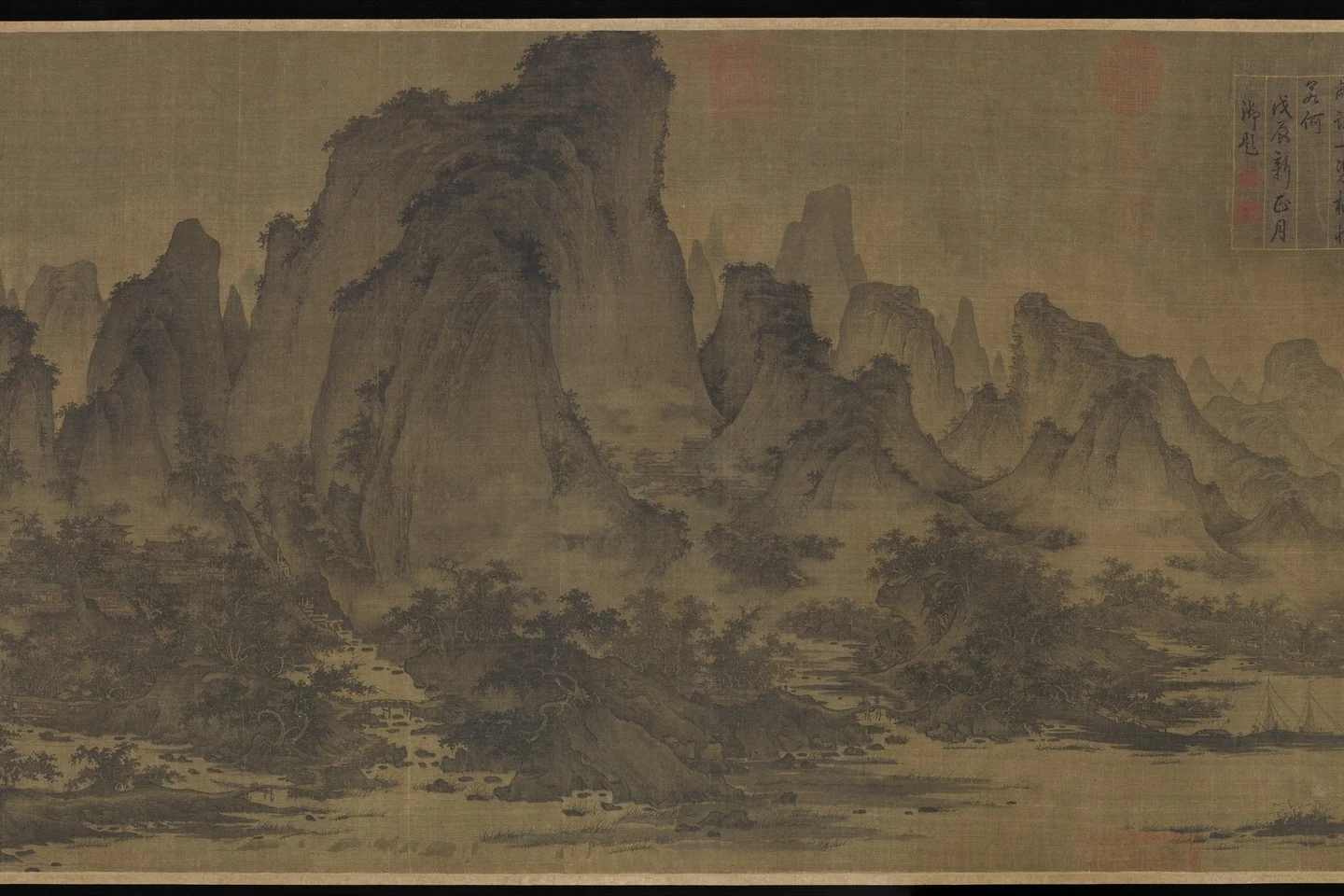 Attributed to Qu Ding
Summer Mountains
ca. 1050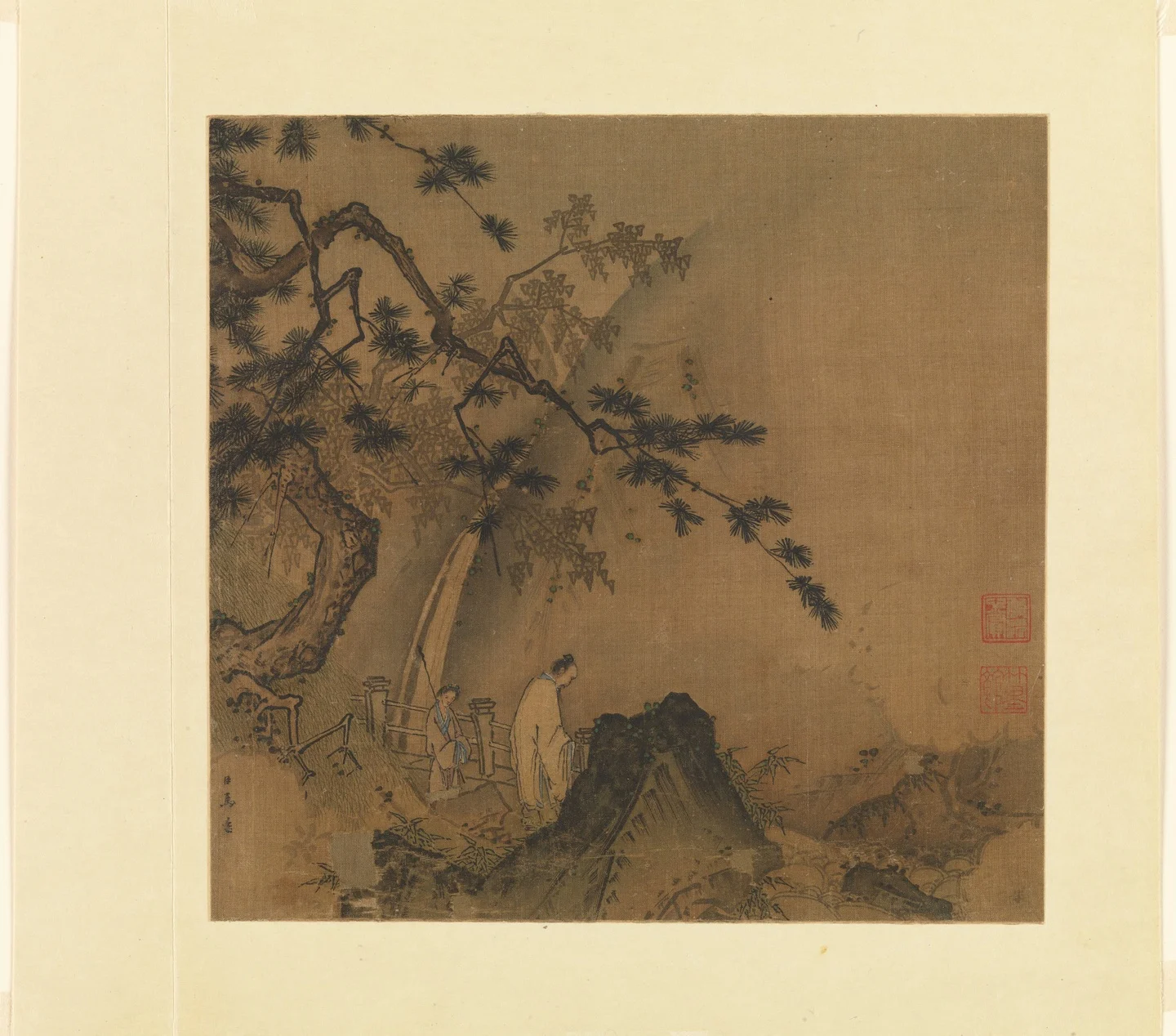 Ma Yuan
Scholar viewing a waterfall
early 13th centuryPeriod, style and subject
- Movement
- Chinese painting
- Genre
- Landscape
- Medium
- Handscroll; ink and color on paper
- Collection
- The Metropolitan Museum of Art
- Dimensions
- Image, 35.6 × 545.5 cm
- Accession number
- 1977.80
Sources
Image provided under CC0. A detail of the scroll. The complete work extends beyond this museum reproduction. Image licence