Woman and Child in a Courtyard
Pieter de Hooch · 1658/1660
Explore the painting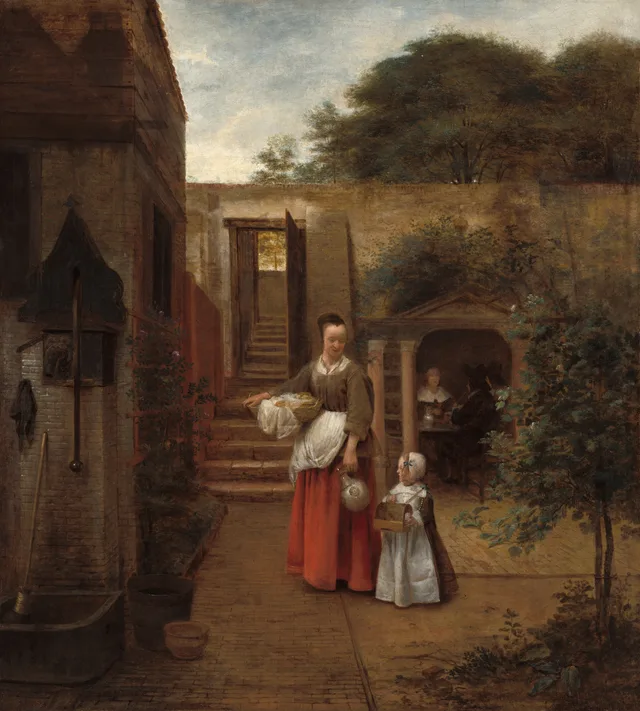
A woman carrying a basket and pitcher pauses beside a child. Three adults sit at a table farther back. De Hooch painted the scene around 1658–1660 in Delft, where courtyards and rooms became his principal subject. Two different activities occupy one home: household duties nearby and conversation and leisure beyond.
The basket rests against the woman’s hip and a pitcher hangs from her other hand. Both hands are occupied, yet her head turns toward the child. This small movement joins household work with attention to someone younger. Care appears within an ordinary sequence of actions, alongside other responsibilities.
The child holds a cage in both hands. Small enough to carry yet requiring care, it stands clearly against the pale apron. Adult and child handle different objects suited to their size and activities. This comparison binds the scene together. Childhood already belongs to the household’s organization, with concerns on a smaller scale.
A bucket, basin, and broom stand below a wall pump. These objects explain how the courtyard stays clean. Water, sweeping, and maintenance require equipment and repeated work. De Hooch carefully paints things usually excluded from formal portraits, giving household management visibility of its own.
The company sits in shade beneath the shelter. A pale pitcher on the table echoes the vessel in the woman’s hand, linking the two spatial levels. The same kind of object belongs to household service and to pleasant leisure. Work and rest coexist visibly without becoming an explicit confrontation.
Steps lead through an open door in the wall to another patch of light. De Hooch favored these sequences of openings because they draw attention into depth. The architecture is convincing even though he could combine separate motifs for compositional reasons. Buildings are selected and arranged as deliberately as people.
Walls shelter the courtyard without excluding sky, trees, or air. This combination of enclosure and openness makes the scene attractive to an urban viewer. Order nevertheless has its conditions. The woman’s occupied hands and the cleaning tools invite us to notice the people whose efforts make a pleasant space available to others.
Featured in tours
Domestic life. Leisure and care
Sixteen paintings about reading, music, children and the work that makes domestic comfort possible.
More works by Pieter de Hooch
- Medium
- oil on canvas
- Collection
- National Gallery of Art, Washington
- Dimensions
- 73.5 × 66 cm
- Accession number
- 1942.9.34
Sources
Museum reproduction. Public domain, NGA Open Access. Image licence