A Dutch Courtyard
Pieter de Hooch · 1658/1660
Explore the painting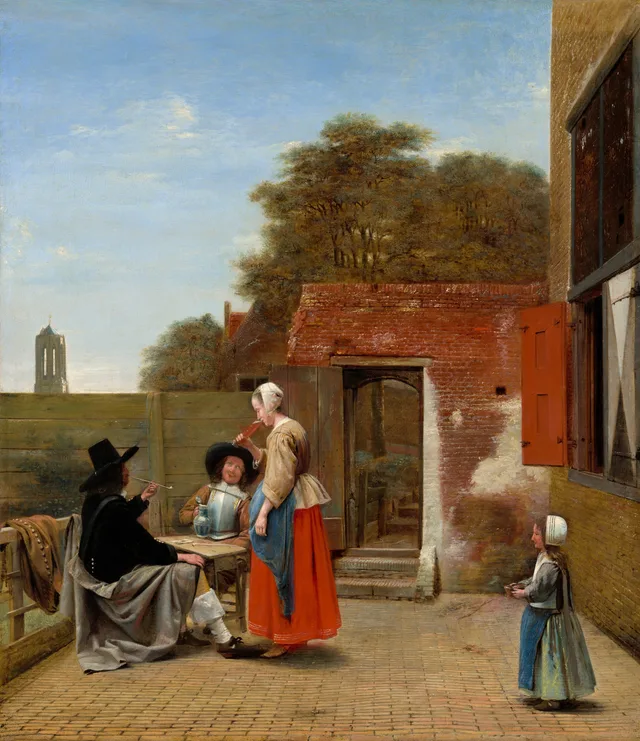
Two men sit at a table, a woman drinks from a tall glass, and a child carries a brazier toward them. De Hooch painted the scene around 1658–1660 during his Delft years. His rooms and courtyards reveal everyday life through spatial arrangements. Several activities occupy a few square steps, but each person has a distinct role.
The nearer man raises a long pipe to his mouth. A cloak rests on his knees and another garment hangs over the enclosure. Clothing and posture establish leisure without a major event. Such pictures offered urban buyers a recognizable world, made attractive through light and order even when the activity was entirely ordinary.
A shining breastplate identifies the second man’s military clothing. Soldiers’ companies were a familiar subject in Dutch painting. He looks toward the woman while holding a tankard. De Hooch gives him no battle narrative; a military figure participates in the everyday city, drinking, talking, and resting alongside others.
The woman stands close to the table with her glass raised. Red skirt and blue apron create the strongest color contrast in the lower scene. Her figure links the seated men with the open door behind her. The gathering can invite thoughts of sociability or courtship, while its visible center remains shared drink and conversation.
The child carries a small brazier containing an ember that could light a pipe. This detail redistributes attention. While the adults relax, the youngest participant serves their leisure. The painting does not make a conflict of it, but a modern viewer can notice the everyday labor that allows other people to spend time at ease.
The open door leads to steps and another section of the courtyard. Brick lines connect near and far space, while irregular masonry keeps the setting from becoming a bare diagram. De Hooch combines calculated perspective with observed, inhabited architecture. The small court feels traversable although the figures barely move.
A church tower rises beyond the enclosure and a broad sky remains above. The private gathering exists within a larger city mostly hidden from view. Everyday life gains a scale of its own and becomes a substantial subject for painting. Yet this attractive world depends on a selective viewpoint: leisure receives a full group, while work is assigned to one small figure.
Featured in tours
Domestic life. Leisure and care
Sixteen paintings about reading, music, children and the work that makes domestic comfort possible.
More works by Pieter de Hooch
- Medium
- oil on canvas
- Collection
- National Gallery of Art, Washington
- Dimensions
- 69.5 × 60 cm
- Accession number
- 1937.1.56
Sources
Museum reproduction. Public domain, NGA Open Access. Image licence