Philemon and Baucis
Rembrandt van Rijn · 1658
Explore the painting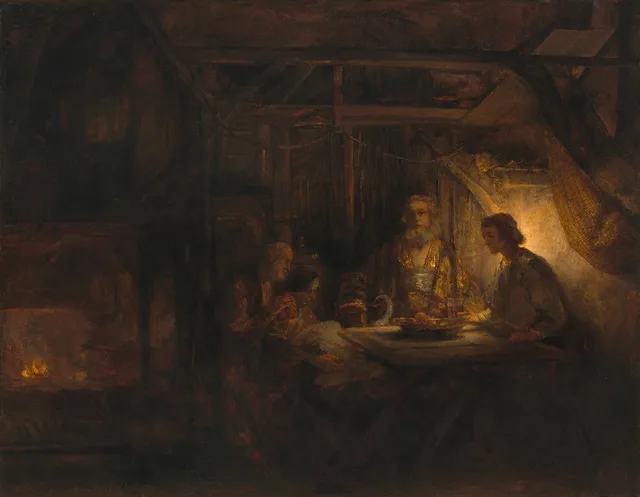
The elderly Philemon and Baucis welcomed two strangers into their poor home, unaware that they were Jupiter and Mercury. In 1658 Rembrandt turned to this story from Ovid’s Metamorphoses, a major source for Dutch painters. The myth explores hospitality through a modest supper with very little to offer.
The old man holds his removed cap against his chest while the woman beside him holds a goose. In Ovid’s story, wine miraculously replenishes itself and reveals the guests’ divinity. The couple wish to sacrifice their only bird for a better meal. That small creature establishes the scale of what they can afford to give.
Jupiter faces us across the table and extends his hand over the modest food, stopping the sacrifice. Rembrandt makes the gesture calm and clear, without thunderbolt or spectacular apparition. Divine power appears through a response to the hosts. What they have freely offered is already enough.
Mercury on the right appears largely in silhouette. Light behind him outlines the turn of his head and an upturned palm. Instead of relying on a brightly lit figure, Rembrandt holds attention through darkness against illumination. This distinguishes the nearer guest from Jupiter while connecting them through exchange.
A small fire glows on the left, separated from the table by a broad dark area. It establishes the poor room’s extent without filling it with detail. Beams and objects emerge gradually. This slow recognition suits a story in which the hosts come to understand whom they have welcomed.
Scholars connect Jupiter’s calm frontal figure with Christ in Leonardo’s Last Supper, a composition Rembrandt knew through a print. An ancient subject thus borrows a form familiar from Christian painting. Ovid’s gods remain themselves, while the reference deepens the gravity of an encounter around a simple table.
The hosts’ poverty does not prevent a worthy welcome. Hospitality is measured by willingness to share rather than the household’s wealth. Rembrandt sustains that idea through the painting’s structure. Supper, room, and figures are modest, yet their relationships command attention. The myth invites consideration of an action before the status of those performing it.
More works by Rembrandt van Rijn


- Medium
- oil on panel transferred to panel
- Collection
- National Gallery of Art, Washington
- Dimensions
- 54.5 × 68.5 cm
- Accession number
- 1942.9.65
Sources
Museum reproduction. Public domain, NGA Open Access. Image licence