A Lady Writing
Johannes Vermeer · c. 1665
Explore the painting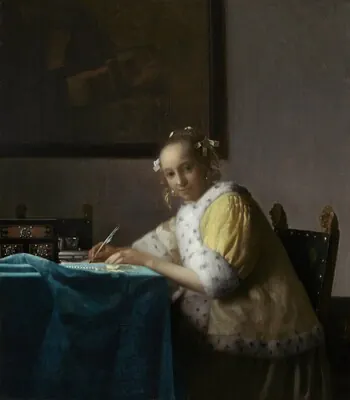
The painting’s story and details
A woman has looked up from her letter towards us. The pen remains in her hand, the paper on the table. Vermeer painted this small canvas around 1665, when domestic activities had become his principal subjects. Early in his career, he had painted biblical and classical stories. Here, an entire scene fits into the brief pause between two lines. The picture does not tell us who is writing, or to whom.
Light picks out her forehead and cheek, while her eyes remain softly shaded. Her lips turn up very slightly. It is easy to take this look as a personal greeting. The museum allows that this may be a portrait, although the woman is unidentified. Our sense of recognition is created by the picture itself. Vermeer turns her face towards us while her body still faces the table, drawing the viewer into that movement.
The pen touches the paper, but we cannot read a single word. A letter implies someone beyond this room, bringing a connection with the outside world into the small interior. We might imagine a love letter, family news or a practical reply, but the image cannot establish which. The artist gives us the act of writing and the woman’s gaze; the substance of her exchange with an absent recipient remains her own.
The yellow jacket with its spotted fur trim looks expensive. It appears in five other Vermeer paintings and is recorded in his household inventory after his death. The museum suggests that cheaper fur may have imitated ermine. This changes how we see the elegant interior. The same belongings helped the painter repeatedly construct a convincing world of comfort and prosperity.
A large dark painting hangs on the wall. A stringed instrument can be made out; the rest recedes into shadow. Its frame occupies almost the whole upper-left area, yet the woman’s illuminated head holds our attention. This contrast determines how much detail we receive. Vermeer could have made the wall painting an easily readable clue to the story. Here it remains obscure, preventing any confident decoding of the letter through it.
The blue cloth rises in a fold before the jewellery box and falls heavily towards the floor. Pearls and a pale ribbon lie beside her hand. Tiny highlights connect them with the earrings and hair ornaments. The broad fabric areas are comparatively quiet, making a few bright points seem especially luminous. From a distance we see an elegant room; close up, we notice how economically the painter produces its lustre.
The painting offers many signs of private life but little access to it. We see clothes, jewellery, writing materials and a returned glance. The woman’s name and words remain unknown. The scene consequently feels unfinished each time we encounter it. Painting creates intimacy with someone we know far better through looking than through any information about her life.
More paintings to compare
Period, style and subject
- Movement
- Baroque
- Genre
- Everyday life
- Medium
- oil on canvas
- Collection
- National Gallery of Art, Washington
- Dimensions
- Overall, 45 × 39.9 cm
- Accession number
- 1962.10.1
Sources
Reproduction of a public-domain artwork. Image licence