Girl with the Red Hat
Johannes Vermeer · c. 1669
Explore the painting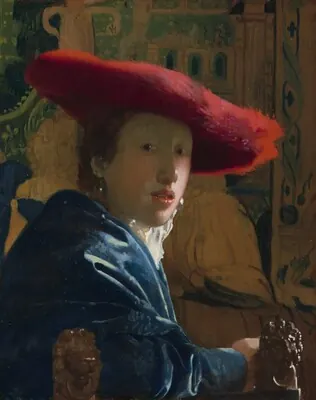
The painting’s story and details
A figure in a broad red hat turns over a shoulder towards the viewer. The painting is very small and made on a wooden panel. The National Gallery dates it to around 1669, when Vermeer began setting light and shade more sharply against each other and leaving his strokes visible. There is no developed domestic narrative. Attention concentrates on the turned head, unusual costume and impression of a close encounter.
The hat spans almost the whole width of the painting. Along its edges, red paint forms loose, sometimes feathered strokes. Vermeer used a surprisingly large brush for such a small work. The hat seems soft without every fibre being described. Its volume emerges from the broad shadow beneath the brim and the vivid red above. This handling asks the eye to assemble form from a few strong contrasts.
Greenish shadow and pink light meet on the face. White accents animate the eye and parted lips, especially beside the soft, almost disappearing edge of the cheek. Vermeer chooses which features to clarify and which to leave indefinite. The impression of a living gaze emerges even where there is very little detailed drawing.
Angular highlights cross the blue clothing. Vermeer scarcely blends them into the deep shadows of the folds. Curator Alexandra Libby relates this handling to his later works, including The Lacemaker. Such comparisons changed the dating of Girl with the Red Hat, formerly often placed around 1666–1667. Brushwork helps reconstruct the experiments of an artist who dated few of his paintings.
The white collar separates the face from the blue fabric, while the dark tapestry keeps the figure close to the foreground. Beneath the present image, researchers found an unfinished portrait of a man. Vermeer turned the reused panel upside down and painted over it. The lower portrait’s authorship remains uncertain. The new scene grew on an existing surface, making the hidden work part of its material history.
The carved lion heads face us. Libby proposes that they belong to a separate chair turned towards the viewer. The figure would then lean on its back, while the seat extends beyond the picture towards us. This explanation of the furniture remains an interpretation. It shows how even the edge of a chair can bring the depicted person closer to someone standing before the painting.
The enlarged highlights on the lion heads have reminded scholars of effects produced by a camera obscura, which projects an image through an opening or lens. Vermeer’s use of one for this painting is unproven. The comparison nevertheless raises a question about representing visual experience. He intensifies spots of light and simplifies contours. The small panel becomes convincing through selective emphasis rather than exhaustive detail.
More paintings to compare
Period, style and subject
- Movement
- Baroque
- Genre
- Portrait
- Medium
- oil on panel
- Collection
- National Gallery of Art, Washington
- Dimensions
- Painted surface, 22.8 × 18 cm
- Accession number
- 1937.1.53
Sources
Reproduction of a public-domain artwork. Image licence